Restaurant Menu Planning to Lower Costs and Improve Sales
Menu planning helps restaurant owners reduce waste, control food costs, improve kitchen efficiency, and increase sales through smarter menu decisions.

Menu Planning Basics
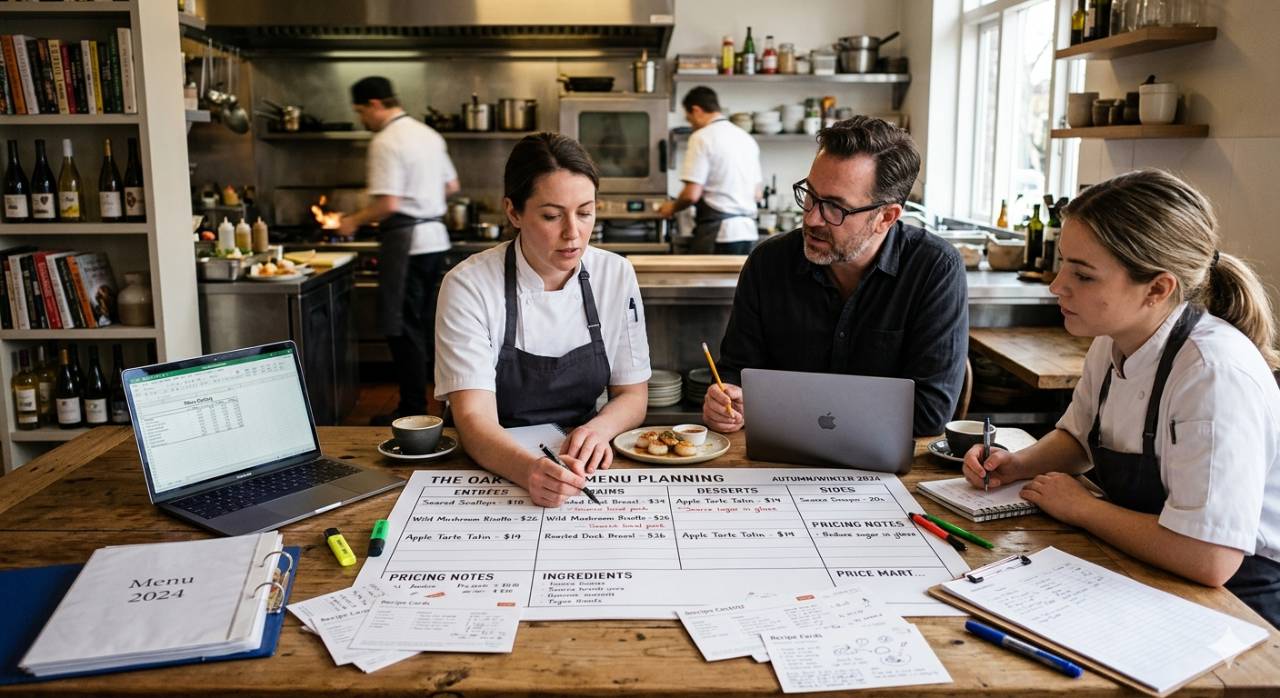
Menu planning is not just about deciding what dishes to offer. It is a structured operational process that determines how your restaurant runs on a daily basis.
At its core, menu planning defines four critical things -
1. What you buy (ingredients and suppliers)
2. How you prep (kitchen workflow and labor needs)
3. How you price (margin and profitability)
4. What you sell most often (demand and revenue mix)
This is why menu planning directly impacts both cost control and sales performance.
When menu planning is treated as a creative task - adding items based on trends or preferences - it usually leads to operational issues. Too many ingredients increase purchasing costs and waste. Complex dishes slow down the kitchen. Inconsistent pricing reduces margins. Over time, these small gaps add up and show up as lower profitability.
On the other hand, when menu planning is treated as an operational system, it creates control.
A well-planned menu is built with clear intent -
- Every ingredient is used across multiple dishes
- Every item can be executed consistently during peak hours
- Every price reflects actual cost and expected demand
- Every section of the menu supports sales goals
This approach reduces unnecessary complexity and makes the kitchen more predictable. It also makes it easier to manage inventory, train staff, and maintain consistency across shifts.
Why Menu Planning Directly Impacts Costs and Sales
Menu planning is one of the few decisions in a restaurant that affects both sides of the business at the same time - cost control and revenue generation.
When the menu is structured correctly, operations become more efficient. When it is not, inefficiencies show up immediately in food cost, waste, and slower service.
Start with cost. A poorly planned menu typically leads to -
1. Excess ingredients - higher purchasing costs and more spoilage
2. Low ingredient overlap - items expire before they are fully used
3. Inconsistent prep - more labor time and more mistakes
These are not isolated issues. They are direct outcomes of menu decisions. If your menu requires too many unique ingredients or complex prep steps, your costs increase automatically - regardless of how well your team performs.
Now look at sales. Menu planning also controls how much you can sell and how efficiently you can serve-
1. Faster execution - more orders completed during peak hours
2. Clear menu structure - easier decisions for customers, leading to higher conversion
3. Well-positioned items - higher average check through add-ons and upgrades
For example, a focused menu with items that share prep steps allows the kitchen to move faster. Faster kitchens handle more volume. More volume directly increases revenue without increasing fixed costs.
The key point is this -
Revenue is not just about demand - it is about how efficiently your menu allows you to fulfill that demand.
When menu planning is done correctly, you create alignment -
- Lower waste
- Faster service
- More consistent output
- Higher sales throughput
That is why menu planning should be treated as a primary lever for improving both margins and growth - not just a design decision.
Choosing the Right Menu Structure for Your Concept
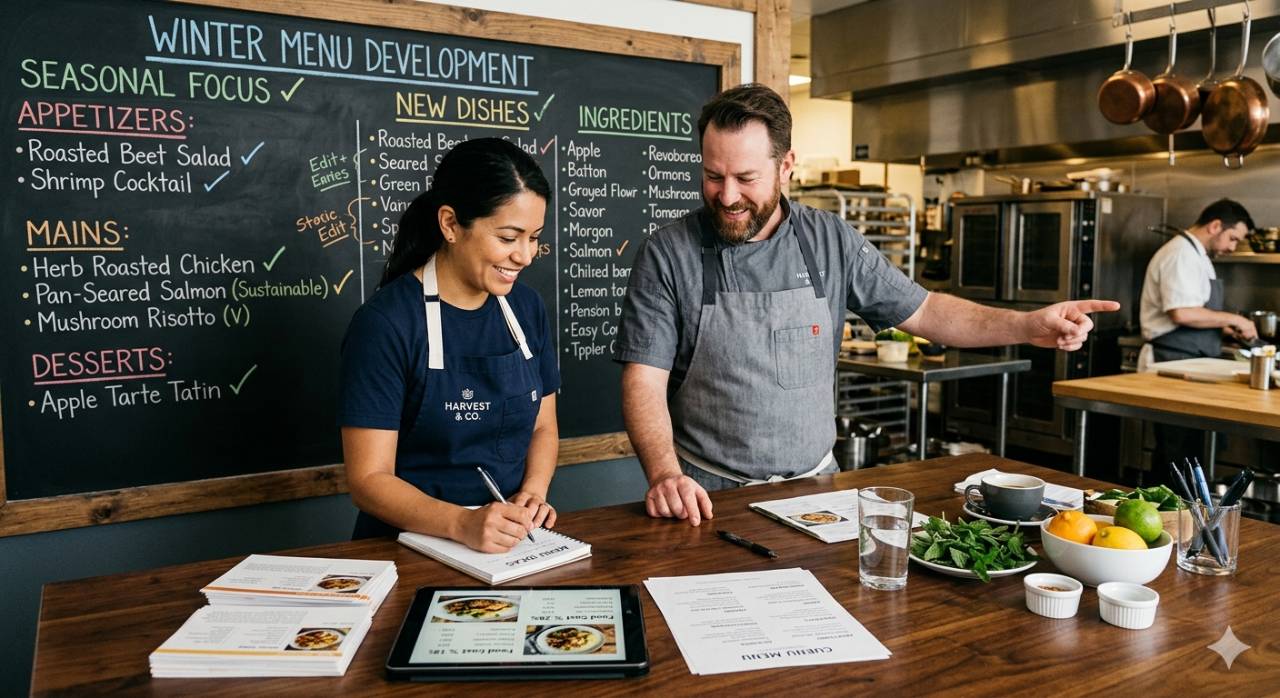
Menu planning is not just about what you serve - it is also about how your menu is structured. The structure you choose directly affects inventory, prep workflow, and how predictable your sales and costs are.
There is no single "best" menu structure. The right choice depends on how much control, flexibility, and simplicity your operation needs.
Here are the most common structures and how they impact operations -
1. Static Menu (Fixed Items Year-Round)
- Best for consistency and operational control
- Simplifies purchasing and training
- Works well for high-volume or standardized concepts
- Risk, limited flexibility if costs change or demand shifts
2. Cycle Menu (Rotating on a Set Schedule)
- Repeats weekly or monthly
- Helps balance variety with predictability
- Makes forecasting and prep planning easier
- Useful for controlling waste while keeping the menu fresh
3. Du Jour Menu (Daily Changes)
- Offers maximum flexibility based on inventory and demand
- Helps reduce waste by using surplus ingredients
- Requires strong operational discipline and communication
- Risk, inconsistency if not managed carefully
4. Fixed or Limited Menu (Set Options or Bundles)
- Reduces decision complexity for customers
- Speeds up kitchen execution
- Improves cost control through fewer ingredients
- Common in fast-casual and high-efficiency models
The key decision is this -
Do you want more control or more flexibility?
More control - lower costs, faster execution, easier training
More flexibility - better response to demand and inventory changes
Most restaurants benefit from a hybrid approach - using a stable core menu for consistency, combined with limited rotation or specials to stay flexible.
If your menu structure does not match your operational capacity, problems show up quickly -
- Inventory becomes harder to manage
- Prep becomes inconsistent
- Staff training becomes more complex
- Costs become less predictable
Choosing the right structure is not a design choice - it is an operational decision that determines how stable and scalable your restaurant can be.
Build Your Menu Around Core Ingredients
One of the most effective ways to lower restaurant costs is to build your menu around core ingredients instead of creating dishes one by one.
Many owners make the mistake of planning the menu from the customer-facing side only. They ask, "What dishes should we offer?" That matters, but the stronger question is - What ingredients can support multiple profitable dishes without creating waste, storage pressure, or prep complexity?
This is where menu planning becomes a cost-control tool.
Start by identifying the ingredients that can be used across several menu items. For example -
1. Proteins that can appear in sandwiches, bowls, salads, or specials
2. Sauces and bases that can be reused across categories
3. Vegetables and sides that support multiple entrees
4. Prep components that can be portioned and repurposed easily
This kind of overlap matters because every unique ingredient adds cost. It affects purchasing, storage, prep time, spoilage risk, and training. When too many ingredients are only tied to one or two dishes, waste increases and margins tighten.
A better approach is to simplify the ingredient list while still giving customers variety. That does not mean making the menu boring. It means creating variety through combinations, formats, and add-ons rather than constantly introducing new inventory.
This also improves buying efficiency. When you purchase a smaller set of core ingredients in higher volume, ordering becomes easier and usage becomes more predictable. Seasonal sourcing can also help here by lowering delivery costs and improving ingredient quality when products are more available.
When owners plan around core ingredients, they reduce waste, protect margins, and make the kitchen easier to run every day.
Design a Menu That Is Operationally Efficient
One of the biggest drivers of cost and inconsistency in restaurants is operational complexity. The more items, variations, and prep steps your menu requires, the harder it becomes for the kitchen to maintain speed and accuracy - especially during peak hours.
Operational efficiency starts with simplification.
Here is what an efficient menu prioritizes -
1. Fewer, Stronger Items - A smaller, focused menu allows the kitchen to execute faster and more consistently. It reduces ticket times, lowers error rates, and improves overall throughput. More items do not mean more sales - often, they slow everything down.
2. Standardized Recipes and Portions - Every dish should have a clear, repeatable process. This ensures -
- Consistent food cost
- Predictable prep time
- Easier staff training
Without standardization, costs vary shift to shift, and mistakes increase.
3. Shared Prep and Equipment Use - Efficient menus are designed so multiple items use the same prep stations, tools, and cooking methods. This reduces bottlenecks and allows the kitchen to handle higher volume without adding labor.
4. Peak-Hour Readiness - Every item on your menu should be evaluated with one question-
Can this be executed consistently during the busiest hour of the day?
If the answer is no, that item creates risk. It slows down the line, delays other orders, and impacts the guest experience.
The key principle is this -
- Complex menus create slow kitchens. Slow kitchens limit sales and increase cost.
An operationally efficient menu does the opposite. It enables faster execution, better consistency, and higher output with the same team and equipment.
This is how menu planning moves from theory to measurable impact - by making daily operations easier, faster, and more controlled.
Price and Position Menu Items for Profitability
Menu planning is not complete when the dishes are chosen. It is only complete when each item is priced and positioned in a way that protects margin.
This is where many restaurants lose money. They build a menu around what sounds appealing, but they do not fully connect pricing to ingredient cost, prep effort, and sales role. As a result, some items sell well but contribute very little profit, while others are priced too high and struggle to move.
A stronger approach is to evaluate every item through three filters -
1. Ingredient Cost - Start with the real cost of the item, including all major components, sides, sauces, and garnishes. If the cost base is wrong, pricing decisions will be wrong too.
2. Labor and Complexity - Two dishes with similar food cost may not have the same impact on profit. If one takes far more prep time, more line attention, or more training, it carries a higher operational cost.
3. Demand Potential - Some items are designed to drive volume. Others are there to generate stronger margins. Your menu needs both, but you need to know which is which.
This helps owners avoid a common mistake - treating all menu items as if they serve the same purpose.
Pricing should also support positioning. High-value items should be easy to notice. Add-ons, upgrades, and modifiers should feel natural, not forced. If profitable items are buried or hard to understand, sales mix suffers.
The key is this - A menu item is not successful just because it sells. It is successful when it sells at the right margin and supports the overall sales mix.
Use Menu Design to Drive Higher Sales
Menu planning does not stop at operations and pricing. It also affects how customers make decisions. A well-designed menu can guide attention, increase average check size, and improve what sells most often.
This matters because customers do not study a menu the way owners do. They scan it quickly. What they notice first, what feels easiest to understand, and what appears most appealing often determines what they order.
That means menu design should support sales goals, not just presentation.
Here are four ways menu design can improve sales -
1. Make High-Value Items Easier to Notice - Your most profitable or most strategic items should be easy to find. If strong-margin dishes are buried in long sections or surrounded by too many similar options, customers are less likely to choose them.
2. Use Clear Descriptions - Descriptions should help customers understand what they are getting without slowing down the decision. When an item sounds more appealing and easier to picture, it becomes easier to sell.
3. Add Customization and Upgrades - Add-ons, portion choices, and simple upgrades can increase check size without requiring a full new item. This gives customers more flexibility while improving revenue per order.
4. Avoid Overcrowding the Menu - Too many options create friction. Customers take longer to decide, staff spend more time explaining, and profitable items get lost. A cleaner menu improves decision speed and sales focus.
Visual presentation also matters. Strong food images and organized layout can increase attention to certain items and make the menu feel more persuasive when used carefully.
When design, layout, and item positioning work together, menu planning becomes a stronger sales tool. Instead of leaving choices to chance, you create a menu that actively helps customers order in a way that benefits both them and the business.
Turn Menu Planning Into a Continuous Process
The most effective restaurant menus are not built once and left alone. They are reviewed, adjusted, and improved on a regular basis.
This is where menu planning becomes a real management discipline.
Customer demand changes. Ingredient costs change. Supplier reliability changes. Seasonal availability changes. If the menu stays static while everything around it shifts, costs rise and sales opportunities get missed.
That is why owners should treat menu planning as an ongoing review cycle, not a one-time setup task.
A practical review process should focus on three areas -
1. Sales Performance - Look at what sells consistently, what underperforms, and what only moves when promoted. This helps you identify which items deserve more space, better positioning, or removal.
2. Food Cost and Waste - Review which ingredients create spoilage, over-ordering, or weak usage across dishes. If an item depends on ingredients that do not move elsewhere, it may be increasing waste more than it is helping sales.
3. Operational Impact - Pay attention to prep complexity, ticket times, and bottlenecks. A dish may look good on paper but create problems during peak hours. If an item slows the line or creates inconsistency, it affects more than just that one plate.
This review does not need to be complicated. It just needs to be consistent. For many restaurants, a weekly or monthly menu review is enough to catch issues before they become expensive.
The goal is simple - keep what performs, improve what can be fixed, and remove what creates cost without enough return.
When owners make menu planning a continuous process, they gain better control over margins, improve menu performance over time, and keep the operation aligned with real business conditions - not assumptions.