Mistakes to Avoid When Systematizing Your Restaurant
Even well-intentioned owners stumble when rolling out operational manuals. Avoid these notorious industry traps to ensure your staff actually embraces the tools you create, rather than resenting them.
The "Binder of Death"
Many operators, desperate for control, print out 80 pages of dense, text-heavy procedures, cram them into a massive D-ring binder, hand it to a new hire on their first day, and say, "Read this." The employee will nod, pretend to read it, and remember absolutely none of it. SOPs are operational reference tools, not a novel. If an SOP is longer than one page, it is too long. Break complex tasks down into smaller, station-specific checklists.
Ignoring Language Barriers in the Back of House
In the United States, the operational backbone of the kitchen relies heavily on staff whose primary language is not English. If you write an intricate, text-heavy SOP exclusively in English, you are setting your Spanish-speaking (or other language-speaking) prep cooks and dishwashers up for guaranteed failure. Always translate your critical kitchen, safety, and sanitization SOPs into the primary languages spoken by your staff. If you skip this step, your SOPs are just expensive wall decorations.
Using SOPs as a Weapon Instead of a Training Tool
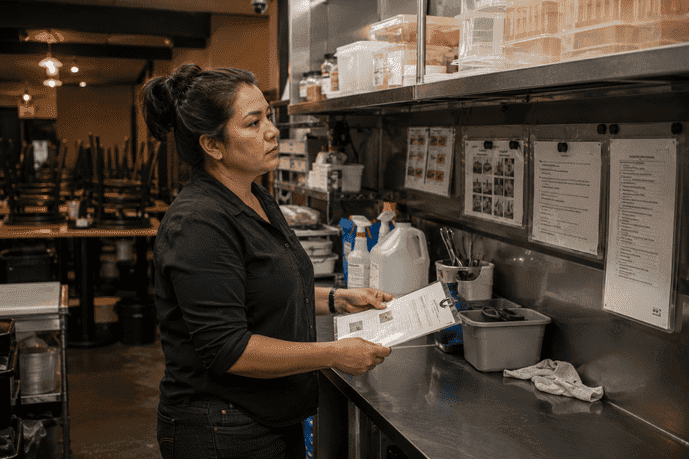
SOPs should never be used purely to micromanage, threaten, or punish staff. If a line cook makes a mistake, your first response as a leader should not be to instantly write them up. Instead, walk them over to the laminated SOP on the wall and use it to guide the correction.
Say, "Hey, I noticed the temp logs weren't filled out right for the walk-in this morning. Let's look at the sheet together. Is there something missing from the instructions, or did we just miss a step today?" This approach shifts the blame from the person to the process, opening the door for constructive coaching rather than defensive arguments.
Failing to Train the Standard
Just because you wrote it down and laminated it does not mean your staff miraculously absorbed the information. Writing the procedure is only step one. Step two is physically walking your team through the procedure during a pre-shift meeting or a dedicated training shift. You must demonstrate the standard before you can hold anyone accountable to it.