Boddie-Noell to Open 31 Scooter’s Coffee in NC, VA
Hardee’s giant Boddie-Noell inks 31-unit Scooter’s Coffee deal for NC and VA, leveraging drive-thru growth and local roots with rollout over 12–18 months.
May 15, 2026
Hardee’s giant Boddie-Noell inks 31-unit Scooter’s Coffee deal for NC and VA, leveraging drive-thru growth and local roots with rollout over 12–18 months.
May 15, 2026
Wingstop turns match weeks into a multi-sensory festival, aligning bold pop-ups with World Cup energy to build brand affinity and measurable momentum.
May 15, 2026
Learn how to develop a memorable restaurant brand identity that stands out in a crowded market, attracts loyal customers, and drives repeat business with actionable strategies and affordable tools.
May 15, 2026
The parent company behind Dunkin', Buffalo Wild Wings, and Arby's has filed for an IPO a move that could reshape how Wall Street views the restaurant sector.
May 15, 2026
Papa Johns has teamed up with Alphabet's Wing for drone delivery of its new sandwich lineup in parts of Charlotte marking the first partnership of its kind between Wing and a national QSR brand.
May 15, 2026
Dirty soda chain Swig is expanding into Colorado through a 10-unit franchise deal, riding a consumer beverage trend that's catching the attention of major QSR players nationwide.
May 15, 2026
A warm, expert-led look at McDonald’s Q1 results, menu makeover, and the refranchise question shaping its growth.
May 14, 2026
A reflective look at Habit Ranch, its immersive desert activation, and what it signals for brand loyalty and mindful, experiential dining.
May 14, 2026
Cousins Maine Lobster pilots a fried-seafood concept in Louisville, expanding through franchising while preserving premium sourcing and guest experience.
May 14, 2026
A warm look at how restaurant scheduling apps and AI are reshaping labor, compliance, and margins from cafés to franchises.
May 14, 2026
Unlock Exclusive Access To Webinars, Events, And The Latest News For Free!
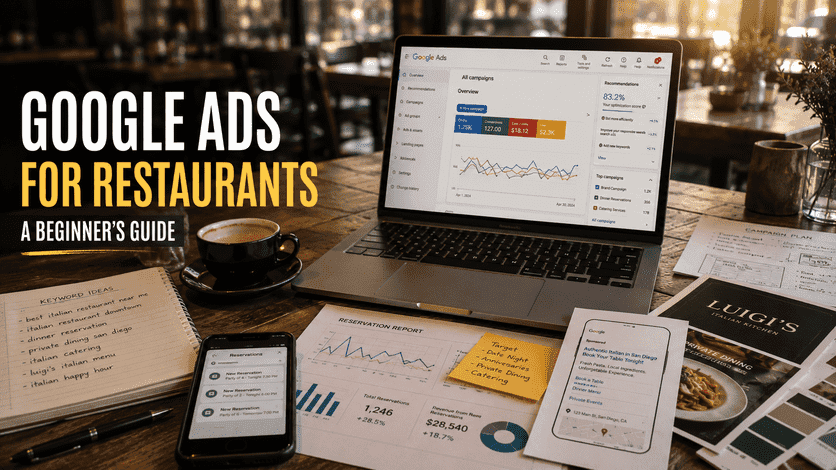
Discover why restaurants relying solely on organic social media struggle to fill tables, and learn the step-by-step Google Ads strategy that can drive high-intent local diners directly to your door—without breaking the bank.

It is 4 PM on a Thursday. Your prep line is fully stocked, the dining room looks immaculate, and your bartenders are standing by the well, wiping down spotless counters. You know you have the best happy hour in the neighborhood, but your reservation book is terrifyingly light. You pull out your phone, snap a gorgeous photo of a signature cocktail, and post it to Instagram, hoping it drives a dinner rush. Three hours later, you have 42 likes from your existing followers, but the door hasn't swung open once.
If you are relying solely on organic social media to fill your seats, you are leaving your revenue to the mercy of a constantly changing algorithm. Social media is fantastic for community building, but it relies on interruption marketing. You are trying to make someone hungry when they are just scrolling through photos of their cousin's dog.
You need to shift your local restaurant marketing strategy toward intent-based marketing. When a user types "best Italian food near me" or "corporate catering downtown" into a search bar, they are not browsing. They have their credit card in hand, and they are making a purchasing decision within the next ten minutes. If your business doesn't appear at the absolute top of that search results page, your competitor down the street gets the table.
That is exactly why you need The Beginner's Guide to Running Google Ads for a Local Restaurant. You do not need a massive corporate marketing budget or an expensive agency retainer to win at search engine marketing. You just need a practical, fiercely protective strategy for your ad spend. Let's build your first profitable campaign.
Google Ads operates on a Pay-Per-Click (PPC) model. You only pay when a hungry diner actually clicks on your ad and lands on your website or calls your phone number.
For independent operators and small chains, this is the ultimate equalizer. A massive corporate steakhouse might have a million-dollar television budget, but if you bid smarter on hyper-local search terms, your independent bistro will show up above them on the search engine results page (SERP).
Furthermore, Google Ads integrates seamlessly with modern restaurant technology solutions. When set up correctly, you can track exactly how many clicks turned into confirmed online orders through your Point of Sale (POS) system, giving you a definitive, mathematically proven Return on Investment (ROI) down to the penny.
Before you give Google a single dollar, you must define what a "win" looks like. Do not run campaigns for generic "brand awareness." In the independent restaurant space, brand awareness does not pay your broadline food vendors. You need measurable actions.
Choose one specific goal for your first campaign -
Your keywords are the foundation of your restaurant search engine marketing strategy. If you bid on the wrong words, you will burn through your budget in hours with zero return.
If you own a sushi restaurant in Austin, Texas, you should never bid on the broad term "sushi." You will end up paying for clicks from people in New York, or people searching for "how to make sushi rice at home."
Instead, focus on high-intent, location-specific keywords -
When your ad appears, you have roughly two seconds to convince the searcher to click. Your ad copy must be punchy, highly relevant, and contain a crystal-clear Call to Action (CTA).
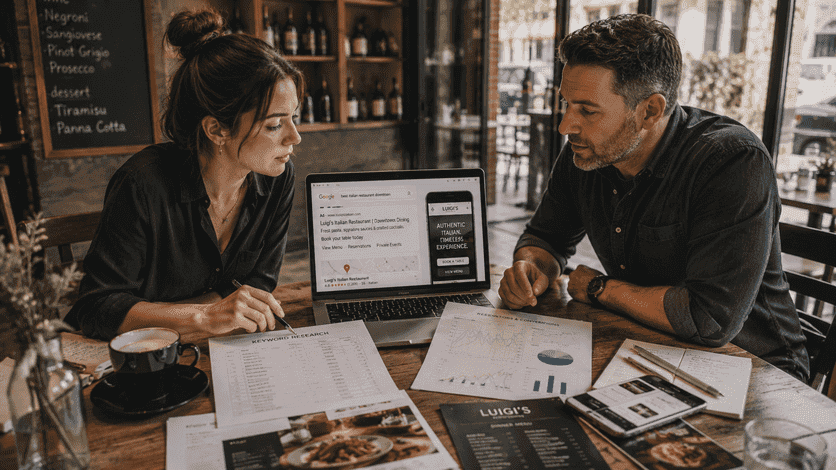
Instead of a boring headline like- "Luigi's Italian Restaurant - Open Now"
Try an action-oriented headline- "Authentic Italian in Downtown | Book Your Table Tonight"
Leverage Ad Extensions-
This is where 90% of local restaurant campaigns fail. An operator will build a brilliant ad, pay $1.50 for a click, and then dump the user onto a slow, cluttered, outdated homepage where they have to hunt for a menu PDF. The user gets frustrated, hits the back button, and that $1.50 is gone forever.
Your landing page must be a seamless continuation of the ad. If your ad promotes "Office Catering Delivery," the user must land on a dedicated catering page.
UI and UX Standards for Restaurants -
Your landing page must feature a modern, clean, and professional UI design. Aim for an "editorial-style" layout think high-impact, full-width photography of your best dishes, ample negative space, and elegant typography. A modern but perfect visual aesthetic builds immediate trust. The layout must be mobile-first, because over 70% of restaurant searches happen on a smartphone.
Place a massive, brightly colored CTA button (e.g., "Order Delivery Now" or "View Catering Menu") right at the top of the page. Remove all friction. Do not make them scroll past a five-paragraph essay about the history of your building just to find the garlic bread.
If your campaign objective is to capture high-value catering or private event leads, relying on your busy General Manager to manually check a generic email inbox is a recipe for lost revenue. Corporate catering clients expect a response within the hour.
You must systematize your lead capture. By utilizing workflow automation platforms (like n8n), you can capture lead data the second a user submits a form on your landing page and instantly route it to the right people.
Set up a workflow that extracts the submitted data from your landing page and automatically pings your management team via a dedicated Slack channel. Simultaneously, you can have the automation push the data directly into your central CRM or Google Sheets. To ensure your sales team isn't working duplicate leads, you can configure the workflow to use a Get row(s) in sheet command to check the client's email against your existing database. If they are a returning corporate client, the system can flag them as a VIP before your events coordinator even picks up the phone.
This level of backend automation ensures you never drop the ball on a $2,000 catering order because the host stand got busy.

You do not need a massive tech stack to launch your first campaign. Stick to these foundational tools -
When implementing The Beginner's Guide to Running Google Ads for a Local Restaurant, what should your expectations be? While metrics vary wildly by city and cuisine, here are healthy benchmarks for an independent operator -
Do not let the Google Ads interface intimidate you. Start small, protect your budget, and scale what works. Use this actionable checklist to launch your first campaign this week -