


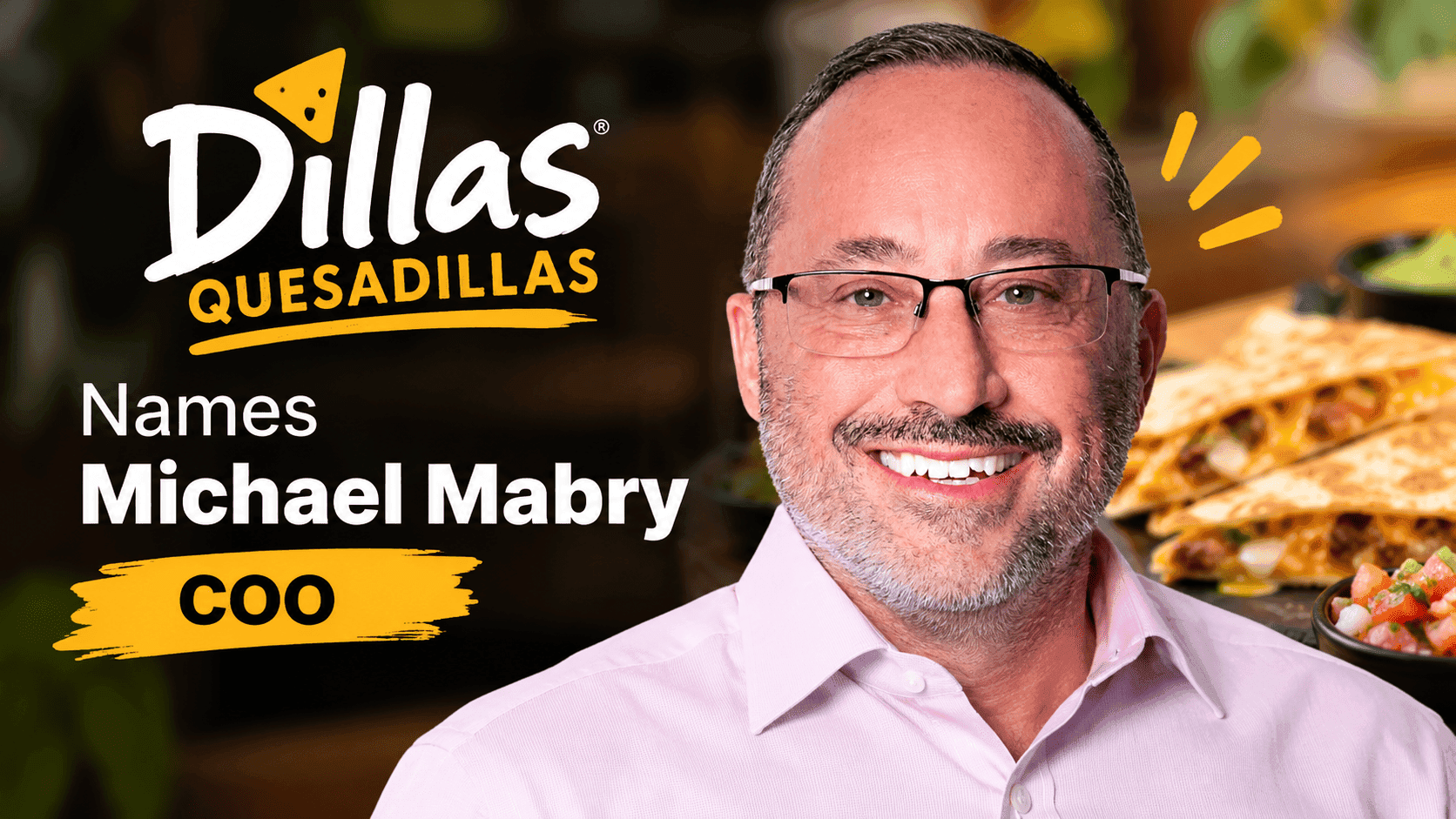
Dillas Quesadillas Names Michael Mabry Chief Operating Officer
Dillas Quesadillas promotes veteran operator Michael Mabry to COO as the chain plans to grow from 11 to 50 units by 2028.
A Stark Growth Bet
Dillas Quesadillas just handed the keys to its operation to a 30-year restaurant veteran, and the math behind that decision is stark: 11 units today, 50 by 2028. That's not incremental growth. That's a company betting its entire operational model can withstand being stretched nearly fivefold in roughly two years.
One Executive, One Mandate
The Dallas-based chain promoted Michael Mabry from head of franchise development into a newly created chief operating officer role, effective Oct. 7, 2026. He now owns day-to-day operations, marketing and franchise sales, a consolidation of authority that tells you something about how Dillas views its own growth ambitions. Spreading those duties across existing staff apparently wasn't going to cut it. The company wanted one executive accountable for turning a stated goal into signed deals and opened doors.
A Résumé Built for Speed
Mabry isn't a stranger walking in cold. He already understood Dillas's franchise development machinery from the inside, and that continuity matters when you're trying to execute at speed. What he brings beyond institutional knowledge is range: president and COO of MOOYAH Burgers, Fries & Shakes, chief development officer of Fuzzy's Taco Shop, president of Famous Toastery. Burgers, tacos, breakfast. Three different franchise models, three different operational structures, all under one résumé. For a brand trying to multiply its unit count this fast, that cross-concept exposure is exactly the kind of experience you want running point.
Quietly Tightening Operations
What makes this promotion less of a gamble than it might otherwise look is the groundwork that preceded it. Dillas spent close to two years quietly tightening its internal operations before making any leadership announcement, simplifying the menu, investing in new technology, streamlining restaurant processes. Those aren't flashy moves, but they're the ones that reduce training time, cut inventory complexity, and make it possible for a new franchisee to deliver a consistent product on day one. The technology piece in particular signals attention to throughput and labor management, the metrics that start to matter a lot more once you're managing dozens of locations instead of a handful.
Testing an Arena Format
The results of that preparation are already visible outside the standard franchise model. Dillas opened its first nontraditional location inside Brookshire Grocery Arena in Bossier City, Louisiana, a venue-based format that departs entirely from the standalone-restaurant playbook. Arena concessions demand condensed footprints and menus built for event crowds, not steady daily foot traffic, so the fact that Dillas is willing to experiment there says something about its appetite for unconventional placement. On the traditional side, the company has six restaurants in development across the Dallas-Fort Worth area, and co-founder and CEO Kyle Gordon has indicated in a press release that more growth is planned for Louisiana. Home market first, Louisiana tested through both a flagship franchise push and an arena unit: that's a regional, methodical rollout, not a scattershot land grab.
Beyond a Novelty
If the Bossier City arena location performs, it could become something more than a novelty. Additional sports venues, entertainment complexes, or similar high-traffic hospitality environments could follow, giving Dillas a second growth lane that builds brand awareness in new markets before a single standard franchise opens its doors there. For a chain this early in its growth curve, that kind of exposure is worth more than it might seem on paper. It's not a replacement for traditional unit development, but it's a complement that costs little to keep testing.
The Risk of Outrunning Readiness
Getting from 11 restaurants to 50 means opening nearly 40 new locations in roughly two years, and that kind of pace has sunk plenty of chains that scaled before they standardized. Dillas seems to understand the risk: menu and technology upgrades first, then the COO hire, then an active pipeline and nontraditional venue testing, in that order. It's a sequence built to avoid the consistency problems that tend to show up when unit count outruns operational readiness. Whether it works depends entirely on execution in markets the company has barely entered, and that makes the next two years less about ambition and more about discipline.