
.png&w=3840&q=70)








Summer 2026 Restaurant Labor Law Updates
Stay compliant with key restaurant labor regulations in Summer 2026, including minimum wage increases, scheduling laws, and retirement requirements.


What Every Restaurant Operator Needs to Know About Summer 2026 Labor Regulations
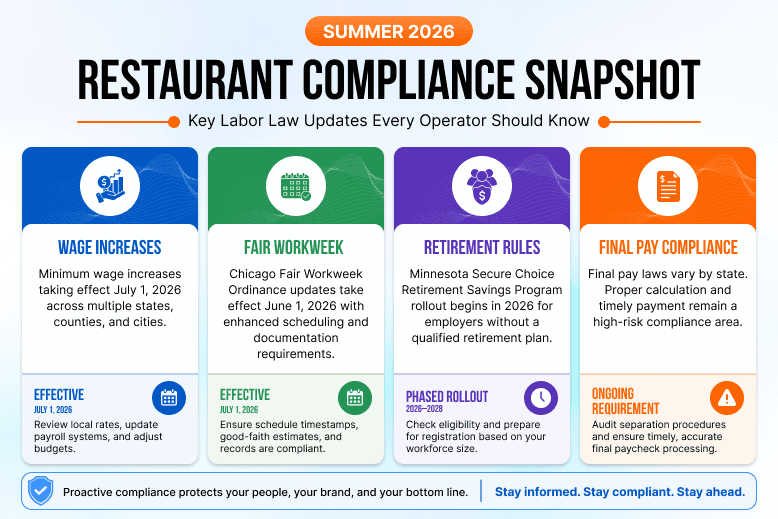
As restaurant operators prepare for the second half of 2026, several significant restaurant labor regulations are taking effect across the United States. From minimum wage increases and scheduling regulations to retirement plan requirements and final pay obligations, these labor law changes for restaurants can directly impact labor costs, compliance risk, employee satisfaction, and profitability. Understanding restaurant labor regulations in 2026 is becoming increasingly important as state and local governments continue introducing new employment requirements that affect scheduling, compensation, payroll, and workforce management practices. While compliance requirements continue to evolve, one thing remains constant - operators who prepare early are far more likely to avoid costly disruptions than those who wait until enforcement begins. Here's a breakdown of the most important labor developments impacting restaurants this summer.
Summer 2026 Compliance Checklist
Before diving into the details, restaurant operators should review the following action items -
| Topic | Effective Date | Recommended Action |
| Local & State Wage Increases | July 1, 2026 | Update payroll systems and labor budgets |
| Chicago Fair Workweek Updates | June 1, 2026 | Ensure schedules include publication timestamps |
| Minnesota Secure Choice | Phased Rollout 2026-2028 | Review retirement plan requirements |
| Final Pay Compliance | Ongoing | Audit termination and separation procedures |
What Are Restaurant Labor Regulations?
Restaurant labor regulations are the federal, state, and local employment laws that govern how restaurants hire, schedule, compensate, and manage employees. These regulations may cover minimum wage requirements, overtime rules, predictive scheduling laws, tip reporting, retirement plan obligations, final paycheck requirements, and employee recordkeeping. For restaurant operators, staying informed about restaurant labor laws is critical because requirements can vary significantly by state, county, and city.
Minimum Wage Increases Continue Across Multiple Markets
July 1 has become one of the most significant compliance dates of the year for restaurant operators. Several states, counties, and municipalities are implementing new minimum wage rates, continuing a trend toward localized wage regulations that often exceed statewide requirements. For multi-unit operators, compliance increasingly requires monitoring city-level ordinances that may vary significantly from one location to another. Key Wage Increases Taking Effect July 1, 2026
| Market | Current Wage | New Wage | Increase |
| Los Angeles City | $17.87 | $18.42 | +3.1% |
| Los Angeles County | $17.81 | $18.47 | +3.7% |
| San Francisco | $19.18 | $19.61 | +2.2% |
| Berkeley | $19.18 | $19.61 | +2.2% |
| Emeryville | $19.90 | $20.34 | +2.2% |
| Pasadena | $18.04 | $18.57 | +2.9% |
| Chicago | $16.20 | $17.05 | +5.2% |
Why These Increases Matter
Labor remains the largest controllable expense for most restaurants. Even seemingly small wage increases can have a substantial annual impact. Example - The Cost of Waiting A restaurant employing 50 hourly employees averaging 30 hours per week could experience the following impact from a $0.50 hourly wage increase -
| Metric | Impact |
| Employees | 50 |
| Average Hours Per Week | 30 |
| Wage Increase | $0.50/hour |
| Additional Weekly Labor Cost | $750 |
| Additional Annual Labor Cost | $39,000 |
- Review all wage increases affecting your location.
- Update payroll systems before implementation dates.
- Adjust labor forecasts and budgets.
- Review menu pricing strategies if necessary.
- Train managers on updated wage requirements.
Chicago Fair Workweek Ordinance Updates
Chicago continues to be one of the most heavily regulated labor markets in the restaurant industry. Effective June 1, 2026, updates to the city's Fair Workweek Ordinance introduce additional clarification regarding scheduling practices, employee documentation, and predictability pay requirements. Key Changes
| Requirement | Previous Requirement | Updated Requirement |
| Workweek Definition | Calendar week references created ambiguity | Employers may define a fixed seven-day workweek |
| Schedule Posting | Schedule posted 14 days in advance | The schedule must also include the publication timestamp |
| Good-Faith Estimate | Basic estimate required at hire | Must include issue date and on-call expectations |
| Tipped Employee Records | Limited documentation requirements | Detailed records of tipped and non-tipped duties are required |
| Predictability Pay | Limited guidance | Expanded clarification regarding qualifying changes |
| Access to Hours | General requirements | Additional guidance and exceptions clarified |
- Provide schedules at least 14 days in advance.
- Offer additional hours to existing employees before hiring externally.
- Maintain compliance records.
- Pay predictability pay when applicable.
- Observe minimum rest periods between shifts unless voluntarily waived.
Minnesota Secure Choice Retirement Savings Program
Minnesota is joining a growing number of states implementing state-facilitated retirement savings programs. The Minnesota Secure Choice Retirement Savings Program requires many employers that do not offer a qualified retirement plan to facilitate employee participation in a state-administered retirement savings program. This requirement reflects a broader trend in restaurant labor laws toward expanded employee benefits and workforce protections. Operators should monitor similar programs emerging in other states. Which Employers May Be Affected?
- Have five or more employees.
- Have operated for at least twelve months.
- Employ workers in Minnesota.
- Do not currently offer a qualified retirement plan.
| Employer Size | Registration Window |
| 100+ Employees | April 1 – June 30, 2026 |
| 50–99 Employees | July 1 – December 31, 2026 |
| 25–49 Employees | January 1 – June 30, 2027 |
| 10–24 Employees | July 1 – December 31, 2027 |
| 5–9 Employees | January 1 – June 30, 2028 |
- Determine whether existing retirement plans satisfy state requirements.
- Review employee eligibility.
- Prepare payroll processes to support future enrollment requirements.
- Monitor registration deadlines based on workforce size.
Final Pay Compliance Remains a High-Risk Area
One of the most overlooked restaurant labor law compliance risks involves final pay obligations when employees separate from employment. Despite receiving less attention than wage increases or scheduling regulations, final paycheck compliance remains a common source of disputes, penalties, and administrative investigations. State requirements vary significantly. Depending on the jurisdiction, employers may be required to provide final wages immediately, within a specific number of days, or by the next scheduled payday. Failure to comply can result in -
- Waiting-time penalties
- Wage claims
- Legal disputes
- Administrative investigations
- Additional payroll processing costs
Best Practices for Restaurant Operators
Develop a standardized process that includes -
| Compliance Area | Recommended Practice |
| Final Wage Calculation | Include all hours worked, overtime, and adjustments |
| Tip Payments | Ensure earned tips are properly included |
| PTO Payouts | Follow state-specific payout requirements |
| Payment Timing | Track deadlines based on employee work location |
| Documentation | Maintain detailed records of final payment issuance |
Compliance Is Becoming an Operational Advantage
Many operators view labor compliance as an administrative burden. However, as restaurant labor regulations become more localized and complex, compliance is increasingly becoming an operational advantage rather than simply a legal requirement. Increasingly, however, the most successful restaurant organizations treat compliance as an operational discipline. Organizations that proactively adapt to wage increases, scheduling requirements, retirement regulations, and final pay obligations often experience -
- Fewer employee disputes
- Lower legal exposure
- Stronger employee trust
- Improved operational consistency
- Better financial forecasting

Key Takeaway
Summer 2026 serves as another reminder that restaurant labor regulations are no longer simply an HR responsibility. Understanding and adapting to restaurant labor laws in 2026 is now a core operational requirement that directly impacts labor costs, employee experience, compliance risk, and long-term profitability. It is a core operational function that directly impacts labor costs, profitability, employee experience, and long-term business performance. The operators who stay informed and prepare early will be best positioned to navigate the changing labor landscape ahead. Note - This article is for informational purposes only and does not constitute legal advice. Please consult counsel for location-specific requirements.