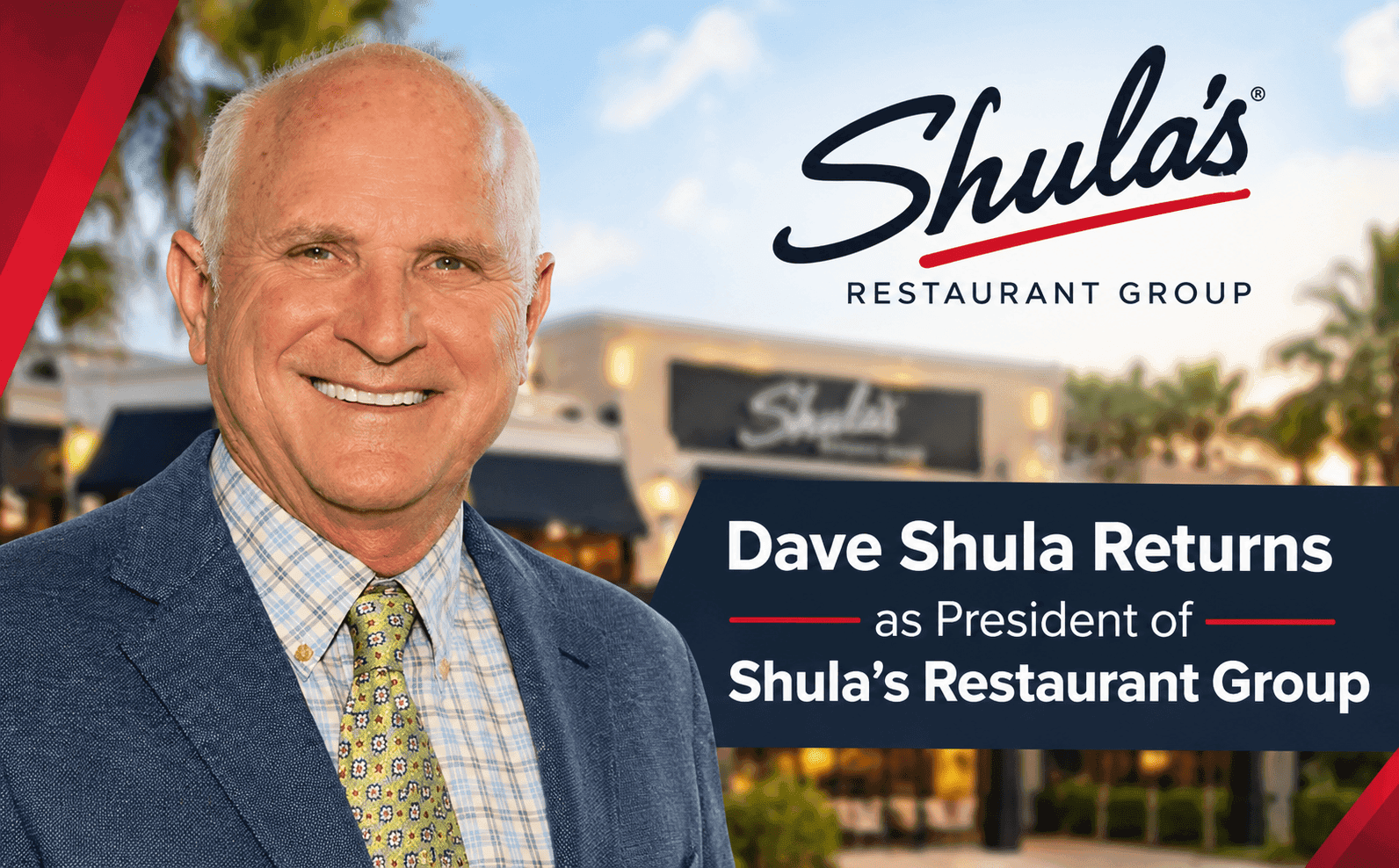
Dave Shula Returns as President of Shula's Restaurant Group
Dave Shula rejoins Shula's Restaurant Group as president, leading growth into Palm Beach Gardens and a 2027 Thomasville, Georgia expansion.
News
Sep 23, 2026
Dave Shula rejoins Shula's Restaurant Group as president, leading growth into Palm Beach Gardens and a 2027 Thomasville, Georgia expansion.
Sep 23, 2026
McDonald's commits $8.5 billion through 2036 to modernize restaurants, boost cash flow by $100,000 per store, and grow chicken and beverage sales.
Sep 23, 2026
WKS Restaurant Group promotes Jay Spongberg to president and COO after he helped grow the company from 65 to 382 restaurants over 16 years.
Sep 23, 2026

Smokey Mo's BBQ names Von Dawson, a Dine Brands veteran, as VP of Franchise Development to lead its Texas expansion strategy.
Sep 23, 2026
.png&w=3840&q=70)
Meritage Hospitality's Chapter 11 filing pulls 5% of Wendy's U.S. stores into bankruptcy, exposing cracks in franchising's bigger-is-safer bet.
Sep 21, 2026
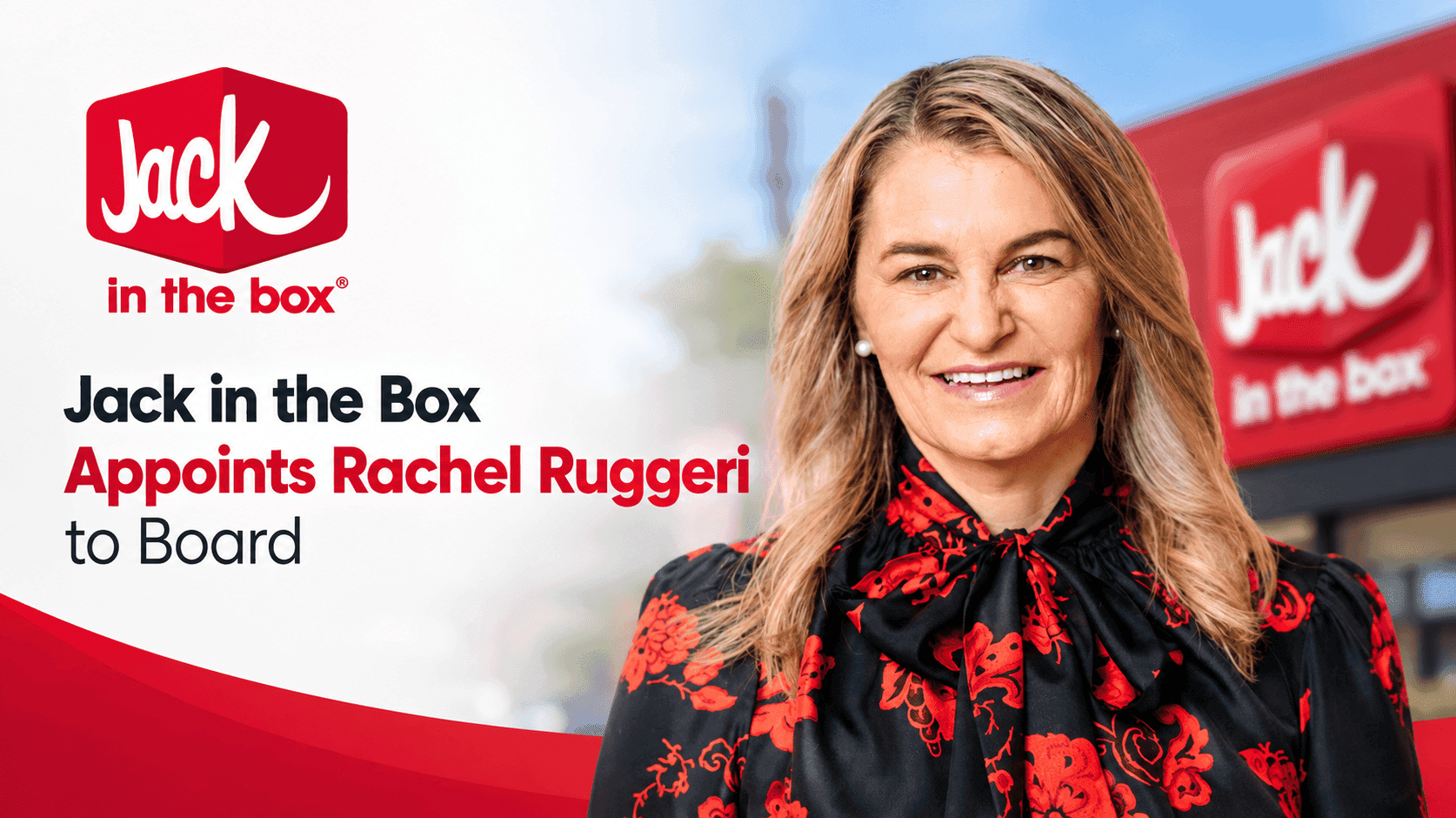
Jack in the Box names Rachel Ruggeri to its board as Michael Murphy retires, amid a CEO transition and deal with investor GreenWood.
Sep 21, 2026

Restaurant inventory tracking helps owners monitor stock, control food costs, reduce waste, improve purchasing, and make informed operational decisions.
Sep 21, 2026
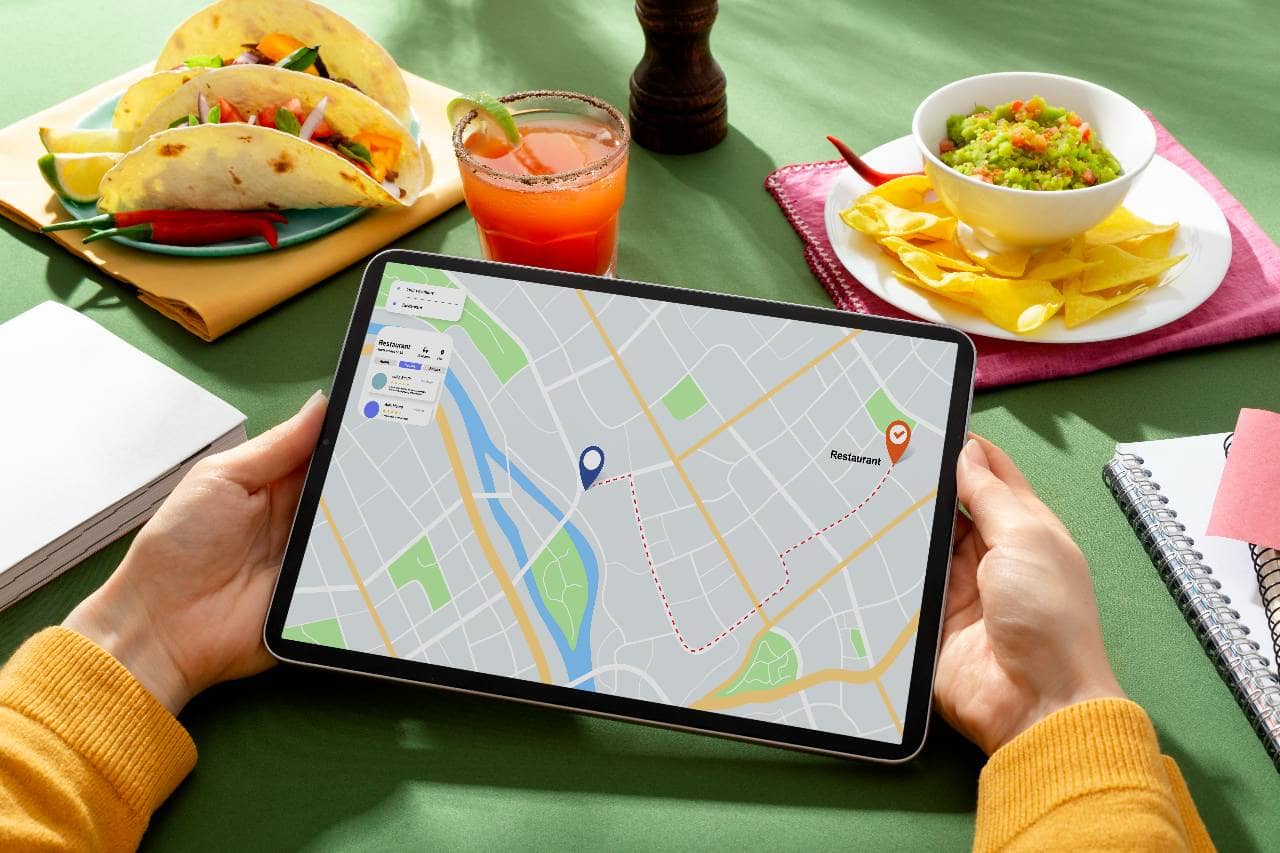
Improve restaurant Google Maps rankings by optimizing your business profile, selecting accurate categories, gathering reviews, adding photos, and strengthening local relevance signals.
Sep 21, 2026

Restaurant owners can significantly reduce restaurant costs by leveraging technology across inventory, labor, procurement, forecasting, and administrative operations for better profit margins.
Sep 18, 2026

Understand how to forecast restaurant revenue and expenses with methods for sales projection, cost scaling, fixed-cost planning, and risk buffering.
Sep 18, 2026

Unlock Exclusive Access To Webinars, Events, And The Latest News For Free!
Every restaurant owner knows the industry is challenging, but failure is rarely caused by a single issue. From labor management and food costs to cash flow and technology decisions, here's what separates struggling restaurants from successful ones.
It's a misconception that 90% of restaurants fail in their first year, despite what you may have heard. Only around 17% of eateries shut in their first year, according to research. In actuality, this is less than the 19% average first-year failure rate for comparable service-based enterprises. Roughly one in three restaurants won't make it through its first year, according to the National Restaurant Association's 30% industry failure rate. These numbers could occasionally make you wonder, "Why do restaurants fail?" Restaurants eventually fail due to a lack of knowledge about what the sector involves. The most important thing you should concentrate on in this situation is information. The majority of restaurant owners are unaware of their mistakes until it's too late. The actual restaurant failure rate tells a very different story. And understanding the real numbers plus the real reasons restaurants fail is the difference between going in prepared and going in blind.
Let's start with hard numbers so you stop operating on myths. According to research from the U.S. Bureau of Labor Statistics, only 17% of restaurants fail in their first year, which is actually lower than the average first-year failure rate of 19% for all other service businesses. The National Restaurant Association puts the estimate closer to 30%, factoring in a broader range of closures. Here is the survival curve that matters-
| Timeframe | Estimated Closure Rate |
| Year 1 | 17%–30% |
| Year 3 | ~30%–50% (cumulative) |
| Year 5 | ~50%–60% (cumulative) |
| Year 10 | ~65%+ (cumulative) |
Restaurant failure rarely traces back to one big blunder. More often, it's a slow buildup of financial blind spots here, an operational gap there, a location that never quite fit, a concept that nobody asked for. Here's an honest look at what actually goes wrong.
| Cost Category | Target Range (% of Revenue) |
| Food Cost | 28%–35% |
| Labor Cost | 25%–35% |
| Rent/Occupancy | 5%–10% |
| Prime Cost (Food + Labor) | 55%–65% |
| Net Profit Margin | 3%–9% |
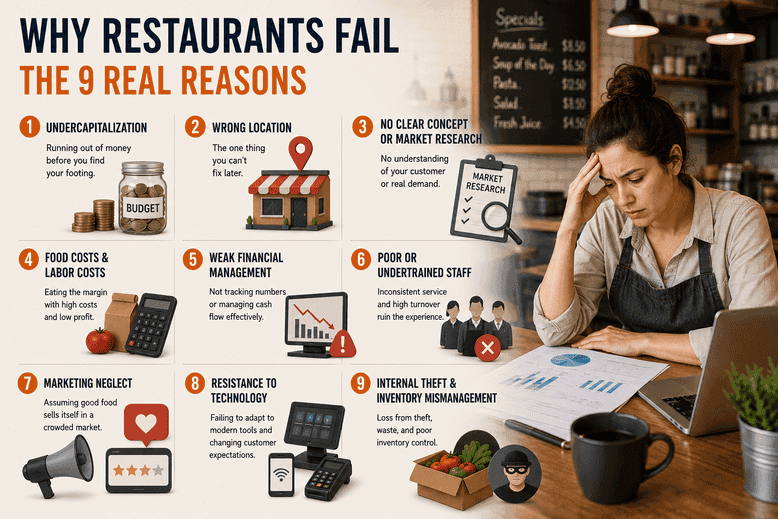
| Failure Reason | Warning Sign | Fix |
| Undercapitalization | Cash flow crises in months 1–6 | Build a 6-month operating reserve before opening |
| Wrong location | Low foot traffic, concept mismatch | Research demographics and competition before signing |
| No concept clarity | Weak repeat customer rate | Define target customer and test concept before launch |
| High food/labor costs | Prime cost above 65% | Review cost reports weekly, adjust menu and staffing |
| Poor financial management | No weekly P&L, no cash flow forecast | Hire a bookkeeper, review financials weekly |
| Staff problems | High turnover, inconsistent service | Invest in training and management systems |
| Marketing neglect | Flat new customer acquisition | Build a retention and acquisition system before opening |
| Technology resistance | No online ordering, poor reviews | Audit your tech stack and adopt tools customers expect |
| Theft/inventory waste | Unexplained cost variances | Implement inventory tracking and cash management controls |
Before you sign anything, sit with these questions honestly- Financial Readiness
The operators still standing at year five tend to have a few things in common that set them apart from the ones who didn't make it. They treat financial data like a daily habit, not something they hand off to an accountant once a year. Food cost, labor cost, prime cost they know those numbers every single week, and they make adjustments before small problems turn into expensive ones. They hire for character and teach the skills. They build kitchen and floor cultures where people actually want to show up, which cuts turnover and keeps the guest experience consistent. They understand that marketing isn't something you spend money on for the grand opening and then forget about. It's an ongoing operational cost, one that directly drives revenue, and they budget for it accordingly. They use technology deliberately. They pick tools that give them real data and operational control, not just whatever looks current or gets pitched to them at a trade show. And maybe most importantly- they never mistake surviving year one for being safe. They know the restaurant failure rate doesn't flatten out after the first year. They plan for the long game from the beginning, not just the launch.
