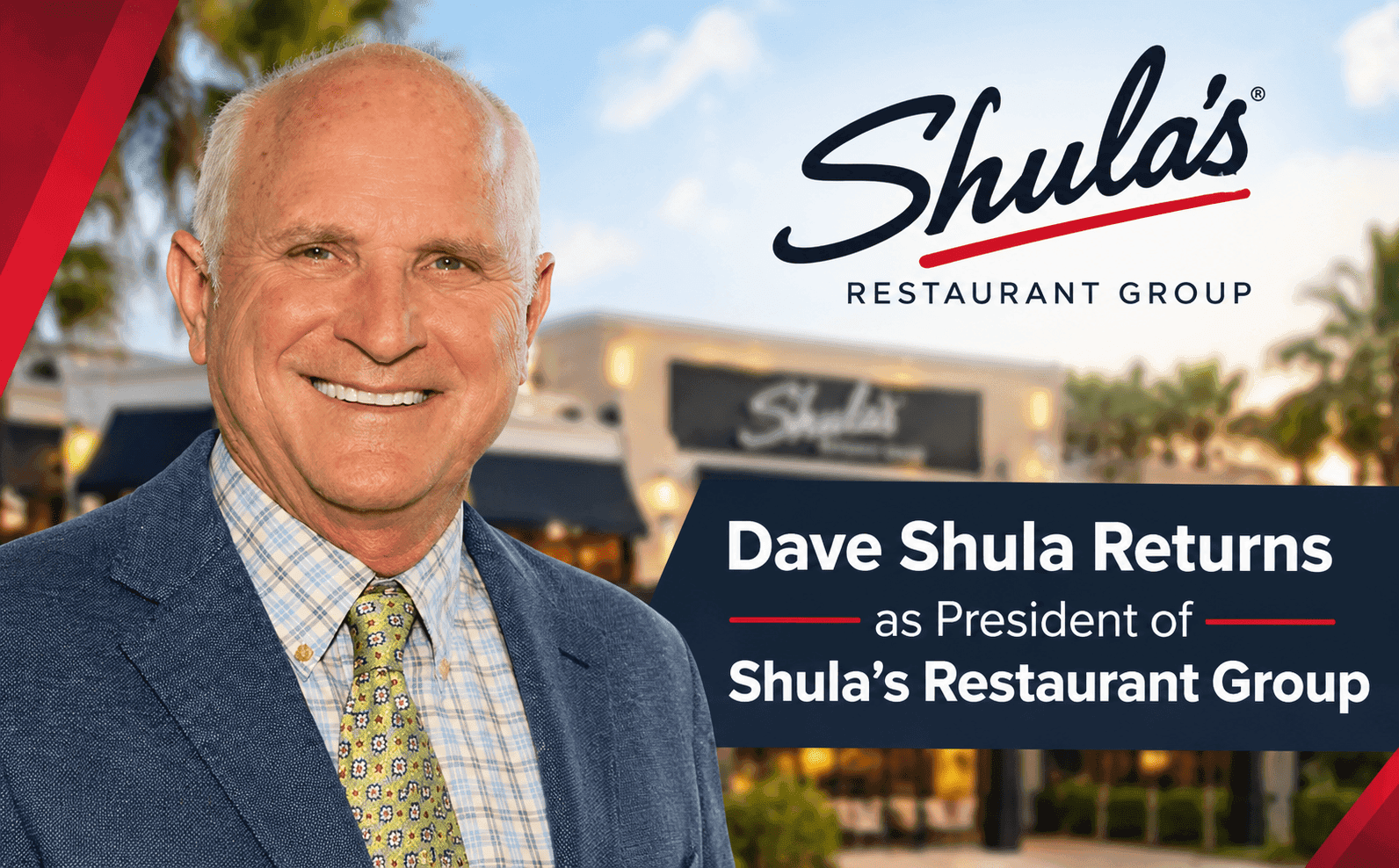
Dave Shula Returns as President of Shula's Restaurant Group
Dave Shula rejoins Shula's Restaurant Group as president, leading growth into Palm Beach Gardens and a 2027 Thomasville, Georgia expansion.
News
Sep 23, 2026
Dave Shula rejoins Shula's Restaurant Group as president, leading growth into Palm Beach Gardens and a 2027 Thomasville, Georgia expansion.
Sep 23, 2026
McDonald's commits $8.5 billion through 2036 to modernize restaurants, boost cash flow by $100,000 per store, and grow chicken and beverage sales.
Sep 23, 2026
WKS Restaurant Group promotes Jay Spongberg to president and COO after he helped grow the company from 65 to 382 restaurants over 16 years.
Sep 23, 2026

Smokey Mo's BBQ names Von Dawson, a Dine Brands veteran, as VP of Franchise Development to lead its Texas expansion strategy.
Sep 23, 2026
.png&w=3840&q=70)
Meritage Hospitality's Chapter 11 filing pulls 5% of Wendy's U.S. stores into bankruptcy, exposing cracks in franchising's bigger-is-safer bet.
Sep 21, 2026

Jack in the Box names Rachel Ruggeri to its board as Michael Murphy retires, amid a CEO transition and deal with investor GreenWood.
Sep 21, 2026

Improve restaurant Google Maps rankings by optimizing your business profile, selecting accurate categories, gathering reviews, adding photos, and strengthening local relevance signals.
Sep 21, 2026

Restaurant inventory tracking helps owners monitor stock, control food costs, reduce waste, improve purchasing, and make informed operational decisions.
Sep 21, 2026

Restaurant owners can significantly reduce restaurant costs by leveraging technology across inventory, labor, procurement, forecasting, and administrative operations for better profit margins.
Sep 18, 2026

Understand how to forecast restaurant revenue and expenses with methods for sales projection, cost scaling, fixed-cost planning, and risk buffering.
Sep 18, 2026

Unlock Exclusive Access To Webinars, Events, And The Latest News For Free!
Explore the impact of California's rejected Proposition 32, a proposed minimum wage increase, on the state's economy and job market.

Photo by Annie Spratt
The decision by Californians to reject Proposition 32, which would have increased the state's minimum wage from $16 an hour to $18 an hour by 2026, has significant implications for the state's labor market and economy. With a narrow margin of 50.8% of voters voting against the proposition, the rejection marks a notable stance on wage policies in the state. Critics of the bill raised concerns about potential further price inflation and job cuts had the proposition passed. This rejection emphasizes the balancing act between wage increases and economic stability.

Photo by Annie Spratt
Even without the proposed minimum wage increase, California maintains one of the highest minimum wage rates in the country. Second only to Washington State, which will reach $16.66 starting Jan. 1, California has doubled its minimum wage since 2010. The state was the first to achieve the $15 threshold, a milestone that emerged from the 'Fight for $15' movements of the past. The rejection of Proposition 32 keeps California's wage policies in line with its history of progressive wage increases.

Photo by Annie Spratt
A notable aspect of California's wage laws is the establishment of a separate minimum wage for fast-food workers. After AB 1228 raised the minimum wage to $20 an hour for most fast-food workers, concerns arose about its impact on the restaurant industry. Reports in June highlighted that price increases due to the legislation led to a decline in restaurant traffic. This trend continued through August, with a nearly 6% decrease compared to national averages. The intersection of minimum wage policies and industry-specific implications is a key area of debate.
While proponents of minimum wage growth argue that increased wages lead to higher spending and economic stimulation, the rejection of Proposition 32 reveals a nuanced public sentiment. Experts suggest that voters were swayed by concerns over price inflation and economic uncertainty, underscoring the delicate balance between wage policies and economic stability. John Kabateck's statement on Californians expressing discontent with rising costs and uncertainty reflects a broader sentiment that influenced the proposition's outcome.
The mixed results of minimum wage legislation across the country on Election Day spotlight diverse approaches to wage policies. While California rejected a wage increase, Alaska's approval of a $15 minimum wage contrasts with Missouri's decision against similar wage growth. These contrasting outcomes reflect the varying economic landscapes and political dynamics shaping wage policies at the state level.

Photo by Annie Spratt
The rejection of Proposition 32 in California demonstrates the intricate considerations surrounding minimum wage policies. Balancing the needs of workers, businesses, and the broader economy remains a complex challenge. As wage policies continue to evolve, understanding the impacts of such decisions on different sectors of the economy is crucial for informed policymaking and economic stability.