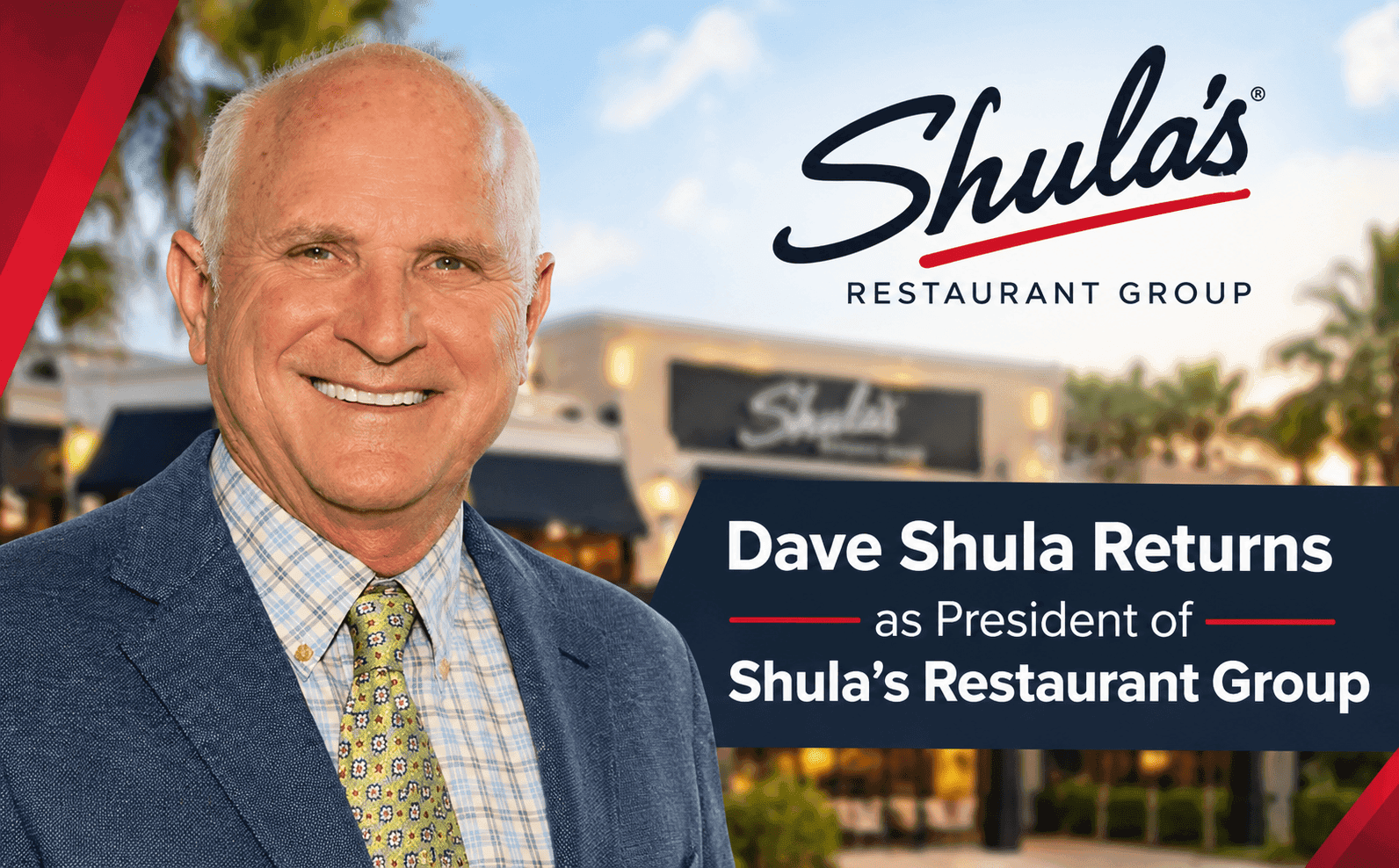
Dave Shula Returns as President of Shula's Restaurant Group
Dave Shula rejoins Shula's Restaurant Group as president, leading growth into Palm Beach Gardens and a 2027 Thomasville, Georgia expansion.
News
Sep 23, 2026
Dave Shula rejoins Shula's Restaurant Group as president, leading growth into Palm Beach Gardens and a 2027 Thomasville, Georgia expansion.
Sep 23, 2026
McDonald's commits $8.5 billion through 2036 to modernize restaurants, boost cash flow by $100,000 per store, and grow chicken and beverage sales.
Sep 23, 2026
WKS Restaurant Group promotes Jay Spongberg to president and COO after he helped grow the company from 65 to 382 restaurants over 16 years.
Sep 23, 2026

Smokey Mo's BBQ names Von Dawson, a Dine Brands veteran, as VP of Franchise Development to lead its Texas expansion strategy.
Sep 23, 2026
.png&w=3840&q=70)
Meritage Hospitality's Chapter 11 filing pulls 5% of Wendy's U.S. stores into bankruptcy, exposing cracks in franchising's bigger-is-safer bet.
Sep 21, 2026

Jack in the Box names Rachel Ruggeri to its board as Michael Murphy retires, amid a CEO transition and deal with investor GreenWood.
Sep 21, 2026

Improve restaurant Google Maps rankings by optimizing your business profile, selecting accurate categories, gathering reviews, adding photos, and strengthening local relevance signals.
Sep 21, 2026

Restaurant inventory tracking helps owners monitor stock, control food costs, reduce waste, improve purchasing, and make informed operational decisions.
Sep 21, 2026

Restaurant owners can significantly reduce restaurant costs by leveraging technology across inventory, labor, procurement, forecasting, and administrative operations for better profit margins.
Sep 18, 2026

Understand how to forecast restaurant revenue and expenses with methods for sales projection, cost scaling, fixed-cost planning, and risk buffering.
Sep 18, 2026

Unlock Exclusive Access To Webinars, Events, And The Latest News For Free!
A look at Domino’s bold international expansion plan, near-term headwinds, and how leadership balances profitability with long-run growth.

Photo by Daniel
Domino’s is betting big on a growth reboot, even as the global map keeps reshaping under pressure. At its Investor Day, the plan called for roughly 1,100 net new restaurants each year for the next five years, a bold cadence built on master-franchise partnerships for 2024 and beyond. The math looked aggressive, but leadership framed it around international scale and disciplined capital. CFO Sandeep Reddy stressed alignment with international franchisees, while executives warned that reality on the ground could blur the forecast. The question every market watcher asks is simple: can the long arc survive short-term volatility, especially in top markets like Japan and France?
That blueprint rests on a global platform with scale to fuel the cadence. Domino’s global footprint sits at about 21,000 stores across more than 90 markets, with roughly 7,000 in the U.S. and more than 14,000 internationally. The China operation reached its 1,000th store in 2024, signaling momentum that can be accelerated in the right markets. The logic is simple: partner with strong operators, unlock high-potential markets, and reinvest for long-run growth. Yet the year that followed underscored a crucial truth: speed can collide with local economics, and openings don’t always land where you expect. The next chapter would test whether the operating plan can translate into sustainable momentum.
Domino’s expansion push aimed to broaden its international footprint through partnerships with master franchisees and to accelerate growth in high-potential markets while keeping profitability in view. The plan framed the global target framework around international collaboration, with a spotlight on markets like China and India, which have emerged as pivotal engines beyond the U.S. The broader global footprint, roughly 21,000 stores in 90 markets, including about 7,000 in the U.S. and more than 14,000 internationally, underscored the leverage available as the markets evolve. In 2024 China opened its 1,000th store, signaling momentum even as teams recalibrate the cadence.
Globally, the push relied on scalable models that lean on franchise partnerships to unlock store growth while pursuing disciplined capital allocation. Beyond the U.S., China and India are central, with China pursuing hundreds of new stores through 2025 and Jubilant FoodWorks signaling thousands more in India. The multi-country push, coupled with a mature but hungry network of international operators, creates a multi-market growth architecture that makes Domino’s longer horizon plausible, provided local economics cooperate. The lesson here is simple: growth isn’t a straight line, and the international engine needs both patience and precision to deliver the big wins.
In practice, Domino’s sought to shore up unit economics by sharpening operations and marketing, especially in key international markets. DPE, the largest international master franchisee, signaled a proactive approach by testing new marketing strategies and evaluating the viability of existing stores. The company outlined a strategy to reroute delivery demand to nearby branches when closures occurred and to roll out global operational playbooks so revenue wouldn’t drift away. France was singled out for a rollout of standardized systems designed to lift operations and customer satisfaction. The plan also called for selective openings, about 20 new outlets in higher-potential markets, to keep momentum without compromising profitability.
Marketing fundamentals got a reboot too, with leadership signaling the appointment of a Chief Marketing Officer to navigate evolving consumer behavior and media dynamics. The broader aim was to ensure that delivery demand could migrate efficiently to surrounding restaurants, minimizing revenue drag from closures and preserving brand momentum. In France, the playbook meant consistent systems across stores, while other markets would see a similar approach when the data justified it. The combined moves, tight marketing, smarter delivery flows, and selective openings, formed the backbone of a plan that hoped to compound growth even when some markets softened.
We continued to engage with the Domino’s Pizza Enterprises team to validate the forecast for the year, and it became clear that the outlook would be impacted as well. said Sandeep Reddy, Chief Financial Officer. The moment captured a dual truth: confidence in the long-term growth curve, paired with near-term headwinds that demanded action. EEAT style signals showed up in the framing: a mature, evidence-based approach to risk, resilience, and value creation across a global, franchise-led system.

Leadership sees a broad set of levers to grow the business, even when quarterly signals soften. said Russell Weiner, Chief Executive Officer. The remarks underscore a disciplined, data-driven mindset that prioritizes alignment with international partners and a selective opening cadence. In short, the leadership tone blends big ambition with grounded risk management, a recipe that keeps the long horizon intact while staying nimble in the near term.
The financial backdrop remained focused on profitability and portfolio simplification. In February 2025, Domino’s Pizza Enterprises signaled a global plan to close 205 loss-making stores, 172 in Japan, aimed at sharpening market focus and improving profitability, with an anticipated annualized savings of about $15.5 million from store closures and accelerated refranchising. The move carried a one-off cost estimated to be around $97 million, with a cash component of roughly $37.4 million. The closures were part of a broader group-wide review initiated in early 2025 to streamline costs and reallocate capital to higher-return opportunities. Separately, leadership described the second-half outlook as challenging but manageable within the longer-term growth framework.

In the U.S., the focus stayed tight on growth, targeting 175 or more net new domestic restaurants annually between 2024 and 2028. In markets outside the United States, performance showed pockets of resilience, with improved delivery efficiency helping to push revenue share upward. The big scoreboard item remains the longer-term plan: 7% global retail sales growth and 8% operating income growth through 2028, a framework that requires both discipline and speed as macro forces shift. The near term is a test, but the ambition endures.
Domino’s expansion beyond the U.S. stays squarely in Asia and Europe, with China as a standout growth engine. China opened its 1,000th store in 2024 and plans a multi-year cadence of openings that keeps the international growth engine humming. In parallel, in India has signaled aggressive expansion, with public discussions about scaling to several thousand outlets over a multi-year horizon as part of a wider multi-country push. This ecosystem lens helps explain why the company remains committed to a long-term expansion framework even as it navigates near-term adjustments.
The broader industry picture matters: a multi-market growth architecture relies on the China and India engines, leveraging partnerships to unlock scale while refining capital allocation. That setup supports the notion that the long-run algorithm can survive a period of cost-readjustments, provided the markets stay aligned with the underlying economics and franchise dynamics.
