
.png&w=3840&q=70)




Robots, Voice AI, and Drones Dominate Chicago Show
At Chicago’s Restaurant Show, robots, voice AI, and drones moved from novelty to hard math, as vendors pitched costs, ROI, and cautious paths to scale.


Photo by Zakaria Zayane
Nostalgia Meets New Code
Three days in Chicago. Plenty of concrete underfoot. The National Restaurant Show pushed one clear message: automation now sits at the pass. Playful booths rang with retro landline phones as a nod to the rise of voice AI, while crowds pressed in around robotics demonstrations and drone cages. The sales pitch stayed practical. Fix labor shortages. Tighten order accuracy. Expand delivery logistics. The floor felt like a back-of-house proving ground, where steel, software, and sensors claim they can hold temperature and tempo better than a tired closing shift. The question lingering in every aisle was simple: what pays back first:
Forecasts gave the moment weight. Global kitchen robotics and automation spending is pegged at USD 5.78 billion in 2026, compounding at 6.5 percent through 2032. The food delivery drone slice aims at USD 0.6 billion in 2026, up 50 percent year over year. And by year-end 2026, as much as 20 percent of orders could route through conversational agents. These are not soft numbers. They’re the kind that move budgets from trials to line items. Still, on the floor, the tech felt most convincing when it wrapped itself in something familiar, like a ringing handset, then showed how it shaved minutes, errors, or both.
The Labor Math Is Brutal
Operators aren’t window shopping. They’re plugging holes. The industry needs an extra 1.6 million workers just to hold service steady. Turnover burns cash. Wage pressure is real. Yet confidence in AI readiness is soft. Deloitte’s late-2024 survey found high experimentation, kiosks, drive-thrus, but low comfort with the talent and governance needed to scale. That gap explains the tone in Chicago. Vendors didn’t sell science fiction; they sold relief. Move what’s repetitive from human hands to algorithms and actuators. Keep people focused on the guest in front of them:

The menu of tasks was specific. Fry station monitoring to lock in hold times. Inventory alerts so ketchup and buns don’t surprise you at 7 p.m. Order assembly to standardize portions and speed. Each claim points at waste already baked into the day: seconds lost, items remade, drivers waiting. The promise is simple: less drift, more repeatability. That kind of discipline doesn’t sparkle, but it scales. In an industry built on consistency, salt, smoke, timing, it’s the right frame.
What the Gear Really Costs
Robot costs
Miso Robotics’ Flippy lands at about USD 75,000 upfront, with roughly USD 3,000 in service and software fees, structured for monthly billing to mirror a single employee slot.
Drone rules
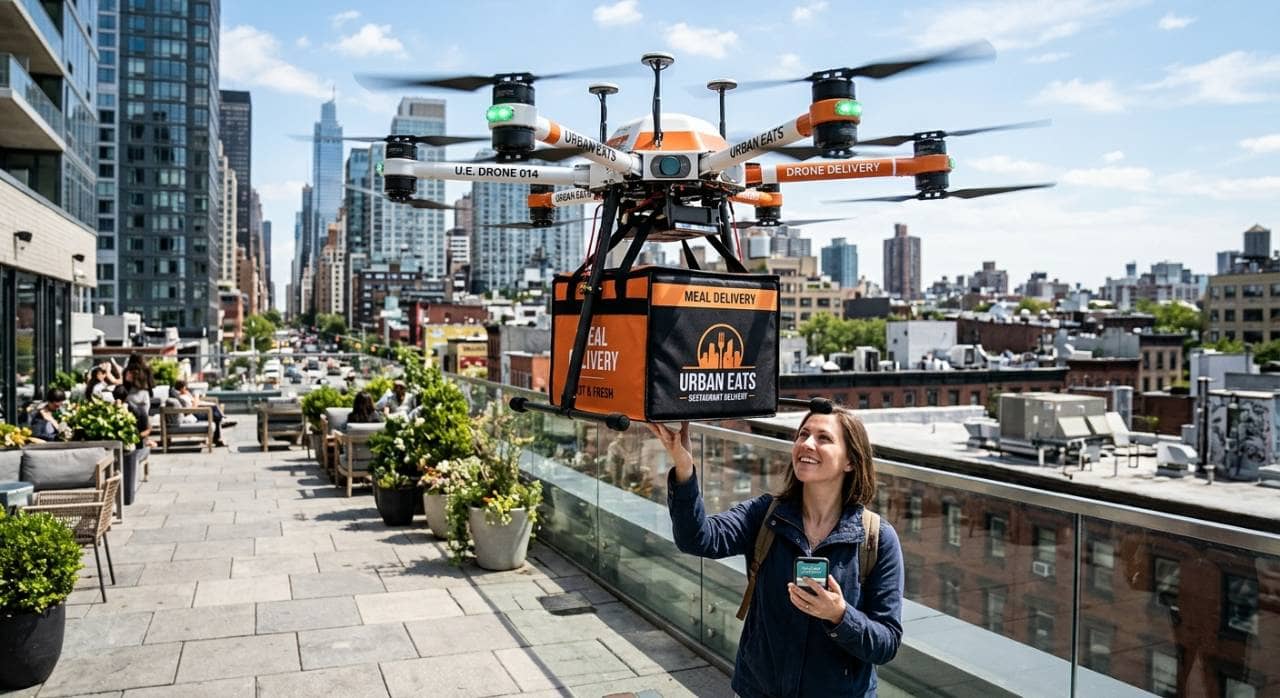
Exhibitors leaned on the new FAA Part 108 framework enabling beyond-visual-line-of-sight, rolling out from July 2026 and linking certification to Part 135 for delivery, promising wider ranges when the airspace is ready.
Voice AI in practice
Vendors used landline handsets to demystify agentic assistants that flag busy patterns, push ketchup-level alerts, and suggest reorder thresholds by tapping existing POS data.
DIY appetite
Some operators, like Amir Harpaz of The Mudpuppy, train open‑source models to post on social and route optimized menu layouts straight to printers, bespoke fixes for immediate pain points.
The theme behind the specs: make automation feel like a familiar tool, not a foreign body. A handset rings. An alert pings. A basket drops. The workflow stays intact while the system trims errors. It’s a cook’s mindset applied to code, tight mise en place, repeatable motion, clean handoff. The risk sits where custom rigs meet scale. What works for one brand line may fray under multi-unit complexity without guardrails.
Leases, Subscriptions, and Straight Talk
Pricing models tried to lower the bar to entry. Miso Robotics told skeptics the fry cook robot is “not as expensive as some operators think,” with leasing to match labor budgets, and a shift to robotics‑as‑a‑service at USD 2,500–3,500 per unit per month. Toast CMO Kelly Esten cut to the chase: “Restaurant people wear a ton of hats. How can we take work that’s not core off their plate with AI?” Then came the operator edge. Khara Mangiduyos of Kalei’s Kitchenette didn’t mince words: “The AI we’re seeing isn’t necessarily solving the immediate problem. That’s why you create your own.” Clear, direct, and telling.

Revenue stories added lift. SoundHound AI reported USD 169 million in 2025 revenue, nearly double year over year, with adoption across 30 percent+ of top 20 QSR chains. Delivery infrastructure for drones still carries compliance loads, remote ID and traffic management, but the pitch points to lower per-order fees at scale. The operator response was measured: pilot first, prove throughput, then commit. Budgets will chase certainty around labor savings and order volume, not sizzle on a screen.
Hype Meets Hard Edges
The projections are bullish, yet traction is uneven. Fewer than one in ten brands report measurable impact from AI pilots. The FAA’s Part 108 path is real but slowed by reopened comments into March 2026, keeping full BVLOS scale tied to local traffic systems. Operator fatigue with buzzwords is visible. There’s also risk in the DIY trend: clever today, brittle tomorrow. That leaves a narrow middle lane. Keep the tech human, run tight tests, and demand proof where it counts, on labor hours, waste, and reach:
- Cut labor hours: Show fewer clocked minutes per item without service drops.
- Reduce stockouts: Prove alerts prevent missed items during peaks.
- Expand delivery radius: Quantify orders added by drones once certified airspace opens.
The test should feel like a normal shift with sharper edges. No heroics, no detours. If a tool can’t slot in and hum, it won’t last beyond the pilot.
There are hints of the payoff. Early adopters like Sweetgreen cite robotic assembly driving roughly 700 basis points of margin improvement, even as same-store sales moved. Pair that with friendlier demos, landlines on booths, and maturing RaaS models, and you get a path from novelty to necessity. The endgame isn’t fewer people; it’s better use of them, more guest-facing, higher-skill, less firefighting.