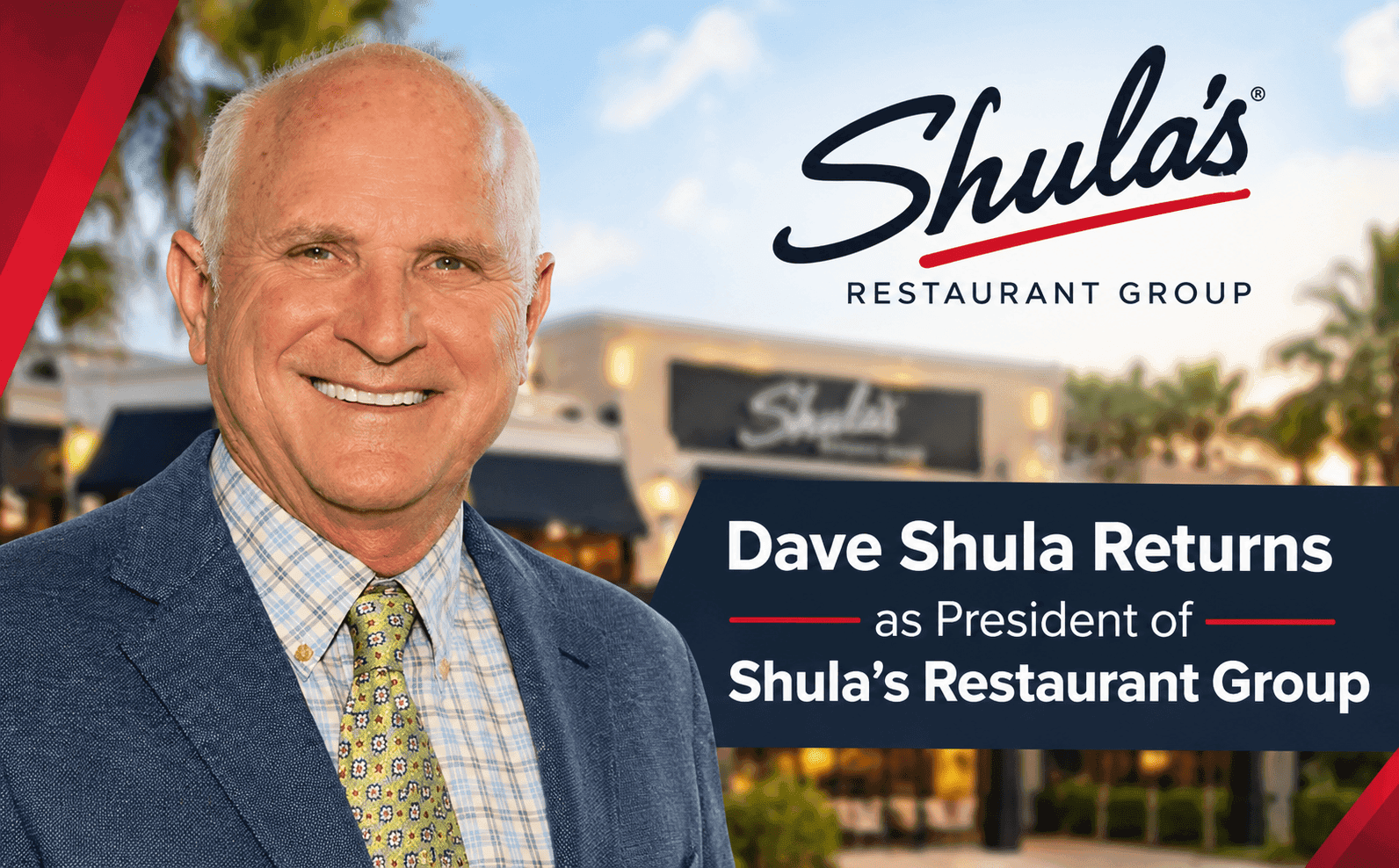
Dave Shula Returns as President of Shula's Restaurant Group
Dave Shula rejoins Shula's Restaurant Group as president, leading growth into Palm Beach Gardens and a 2027 Thomasville, Georgia expansion.
News
Sep 23, 2026
Dave Shula rejoins Shula's Restaurant Group as president, leading growth into Palm Beach Gardens and a 2027 Thomasville, Georgia expansion.
Sep 23, 2026
McDonald's commits $8.5 billion through 2036 to modernize restaurants, boost cash flow by $100,000 per store, and grow chicken and beverage sales.
Sep 23, 2026
WKS Restaurant Group promotes Jay Spongberg to president and COO after he helped grow the company from 65 to 382 restaurants over 16 years.
Sep 23, 2026

Smokey Mo's BBQ names Von Dawson, a Dine Brands veteran, as VP of Franchise Development to lead its Texas expansion strategy.
Sep 23, 2026
.png&w=3840&q=70)
Meritage Hospitality's Chapter 11 filing pulls 5% of Wendy's U.S. stores into bankruptcy, exposing cracks in franchising's bigger-is-safer bet.
Sep 21, 2026

Jack in the Box names Rachel Ruggeri to its board as Michael Murphy retires, amid a CEO transition and deal with investor GreenWood.
Sep 21, 2026

Improve restaurant Google Maps rankings by optimizing your business profile, selecting accurate categories, gathering reviews, adding photos, and strengthening local relevance signals.
Sep 21, 2026

Restaurant inventory tracking helps owners monitor stock, control food costs, reduce waste, improve purchasing, and make informed operational decisions.
Sep 21, 2026

Restaurant owners can significantly reduce restaurant costs by leveraging technology across inventory, labor, procurement, forecasting, and administrative operations for better profit margins.
Sep 18, 2026

Understand how to forecast restaurant revenue and expenses with methods for sales projection, cost scaling, fixed-cost planning, and risk buffering.
Sep 18, 2026

Unlock Exclusive Access To Webinars, Events, And The Latest News For Free!
A warm, expert look at how tech upgrades and value-focused moves are steering Outback and peers toward a rebound in a softer dining landscape.

Photo by Sergey Kotenev
Across casual dining, a shared headwind is nudging brands toward sharper precision in operations. In the latest momentum around Outback Steakhouse and its peers, traffic has softened, a trend echoed across the sector rather than a misstep by any single name. The environment is demanding more than incremental tweaks: it calls for a holistic repositioning that blends efficiency with a warmer guest touch. In this moment of adjustment, the story is less about one brand and more about a broader shift toward value, speed, and hospitality that can win back diners who are watching prices and experiences closely. The core question is how the turnaround unfolds in real time, in the dining room and at the tabletop, where every moment counts as a signal of momentum.
Outback’s 3.8% traffic decline sits in a larger conversation about shifting demand and macro pressures. BLOOMIN’ Brands has framed the moment as an opportunity to reset what guests expect from a casual-dining visit: speed, warmth, and a clear value proposition. The footprint of the discussion extends to rivals like Denny’s, Denny’s peers’ remodeling programs, and technology upgrades that speed service and improve accuracy. As observers note, the numbers reflect broad macro forces rather than brand missteps, yet the moral is clear: sharper execution and value-first offers are part of stabilizing visits in a softer environment.
Technology and asset upgrades sit at the heart of the turnaround. The plan centers on improving order speed, throughput, and the guest experience, with new grills and systemwide server handheld devices designed to shorten the path from order to plate. A broader four-platform framework guides the journey: deliver a remarkable dine-in experience, reignite brand relevancy, rebuild a culture of ownership and fun, and invest in assets that refresh the guest journey. These pillars are supported by productivity savings that don’t worry the guest, balanced capital allocation, and a leadership team focused on execution and guest-centricity. It’s hospitality with a gentle, modern edge.

Meanwhile, the menu is being simplified to highlight high-satisfaction items while preserving exclusive offerings not found elsewhere. The value narrative is reinforced by promotions such as a three-course option starting at $14.99, positioned as a weekend or limited-time lure to attract price-conscious guests. On the operational side, non-guest-facing productivity savings and a dialed-in marketing cadence are meant to lift throughput without sacrificing warmth. Taken as a whole, these moves mirror a broader industry rhythm: efficiency paired with clear value to lift visits and sustain brand health.
The leadership team has been careful to frame improvements as part of a longer horizon. Executives point to gains in guest perceptions and service benchmarks, especially in steak preparation accuracy and consistency of experience, as well as in the friendliness of service and food quality. The message is steady rather than sensational: better execution, asset modernization, and targeted marketing are meant to restore traffic and profitability over time. A representative refrain captures the optimism: "We know that over time, these level[s] of improvement will help drive same-store sales growth." The language reflects discipline, KPI-driven progress, and a patient path toward a stronger, more resilient brand.

Beyond the internal voice, observers watch peers for context. The strategy echoes a broader industry cadence: Denny’s moves to prune underperformers and sharpen value messaging, while data from Placer.ai suggests visits for casual dining stabilized in the first half of 2025. The takeaway isn’t a single winner’s curve, but a landscape in which technology investments, menu discipline, and purposeful marketing are shaping the tempo of recovery for many brands, Outback included.
Uncertainty remains about the pace and depth of traffic rebound. The durability of value promotions, the impact of menu simplification, and the ability of tech-enabled operations to sustain improvements in speed and accuracy will likely dictate the speed of recovery. Remodels form a centerpiece of the longer-term plan, with expectations of refreshing a large swath of the footprint to keep the dining experience modern and engaging. The scope is sizable, 60 to 65 Outback locations to remodel and 40 to 45 new outlets planned for the year, but the timing and impact depend on market dynamics and sustained guest satisfaction.
Analysts remain cautiously optimistic that the four-platform framework, paired with discipline in menu and pricing, can restore demand. The remodel program is seen as essential to maintaining relevance in a crowded field, even as macro pressures linger. The industry narrative, remodels, technology, and focused marketing, frames Outback’s pathway as one example of how casual dining is recalibrating to a new dining-consumer reality, with steady progress toward a more stable trajectory.
