.png&w=3840&q=70)
Wendy's Top Franchisee Bankruptcy Exposes Growth Risks
Meritage Hospitality's Chapter 11 filing pulls 5% of Wendy's U.S. stores into bankruptcy, exposing cracks in franchising's bigger-is-safer bet.
Franchising
Sep 21, 2026
Meritage Hospitality's Chapter 11 filing pulls 5% of Wendy's U.S. stores into bankruptcy, exposing cracks in franchising's bigger-is-safer bet.
Sep 21, 2026
Jack in the Box names Rachel Ruggeri to its board as Michael Murphy retires, amid a CEO transition and deal with investor GreenWood.
Sep 21, 2026
Understand how to forecast restaurant revenue and expenses with methods for sales projection, cost scaling, fixed-cost planning, and risk buffering.
Sep 18, 2026
Restaurant owners can significantly reduce restaurant costs by leveraging technology across inventory, labor, procurement, forecasting, and administrative operations for better profit margins.
Sep 18, 2026

everbowl names Anna Gabele Brand President and Natalie Trzcinski COO, pulling both from Jack in the Box to guide its next growth phase.
Sep 18, 2026

Mountain Mike's Pizza hires Jack in the Box veteran Sheena Dougher as CMO to drive national growth while preserving its regional brand identity.
Sep 17, 2026

From fixed costs to contribution margin, learn exactly how to calculate your restaurant's break even point with confidence.
Sep 16, 2026

DoorDash pays $425M for Wonder's campus dining platform and a stake in Wonder, betting on robotic kitchens and institutional foodservice growth.
Sep 16, 2026
Discover the most common reasons restaurants fail, including inconsistent food quality and pricing mistakes, plus practical ways to avoid them.
Sep 16, 2026
Chipotle names former KFC global CEO Sabir Sami to its board as the chain expands into Mexico, Saudi Arabia, and South Korea.
Sep 15, 2026

Unlock Exclusive Access To Webinars, Events, And The Latest News For Free!
Learn the top marketing strategies pizzerias can use to attract local customers, increase direct orders, and build stronger repeat business.

Pizza is one of the most competitive restaurant categories because customers have many choices. An independent pizzeria is not only competing with nearby pizza shops. It is also competing with national chains, delivery apps, frozen pizza, grocery meals, fast-casual restaurants, and every other option fighting for the same lunch or dinner order. For many owners, the problem is not the food. A pizzeria may have great dough, fresh toppings, strong service, and loyal regulars, but still struggle to grow if new customers do not discover it. In a crowded market, good pizza needs visibility. Customers need to find the restaurant online, remember it when they are hungry, trust it before ordering, and have a reason to return. This is why pizza marketing matters. A strong marketing system helps turn a local shop from "another option" into the first place customers think of when they want pizza. It also helps reduce dependence on third-party delivery platforms, where fees can lower margins and customer relationships often stay with the app.
New mover marketing works because it reaches customers at the exact moment their buying habits are changing. When someone moves into a new neighborhood, they usually need to find a new grocery store, coffee shop, dry cleaner, pharmacy, and go-to pizza place. If a pizzeria reaches that household before competitors do, it has a better chance of becoming part of the customer's normal routine. This is especially important for independent pizzerias because pizza is often a repeat-purchase category. A family that likes one order may come back weekly, order for sports nights, buy during parties, add wings or salads, and recommend the restaurant to neighbors. That makes the first order more valuable than the first ticket amount. A $25 or $35 order may look small, but if that household orders twice a month, the annual value can become much higher. Direct mail can also be more focused than general advertising. Instead of sending coupons to every household in a ZIP code, a pizzeria can target people who recently moved into the delivery area. The list can also be filtered to improve return on investment. For example, owners may want to prioritize families, true out-of-town movers, nearby households, or income levels that match the restaurant's pricing. This helps avoid wasting offers on customers who are less likely to order. A strong new mover campaign may include - 1. A clear target area - Focus on households within a realistic pickup or delivery radius. A great offer is less effective if the customer lives too far away to order regularly. 2. New resident timing - Send the mailer soon after the move, before the household builds new restaurant habits. 3. Household filtering - Families, higher-income households, and true new residents may have stronger long-term value than broad, unfiltered mailing lists. 4. A personal welcome message - A letter from the owner can feel more local and trustworthy than a generic coupon. 5. A high-value first offer - A free pizza, strong discount, or family meal deal can reduce hesitation and make the first order easier. 6. Mouthwatering food visuals - The mailer should show the product clearly. Pizza is visual, and a strong photo can create immediate appetite. 7. Simple ordering instructions - Include the website, phone number, QR code, address, hours, and delivery details so the customer knows exactly how to order. 8. Repeat-order strategy - The goal should not stop at redemption. Add a follow-up offer, loyalty invitation, or email/text signup to bring the customer back. The economics of new mover marketing depend on lifetime value. A pizzeria may lose margin on the first offer, especially if the promotion is generous. However, the first order can also lead to add-ons such as drinks, wings, desserts, salads, or extra toppings. More importantly, it gives the restaurant a chance to win a customer who may order for months or years. For this strategy to work, owners should track redemptions carefully. Each mailer should use a unique coupon code, QR code, or offer name so the restaurant can measure how many new customers ordered, how much they spent, and whether they came back. Without tracking, direct mail becomes guesswork. With tracking, it becomes a repeatable customer acquisition system.
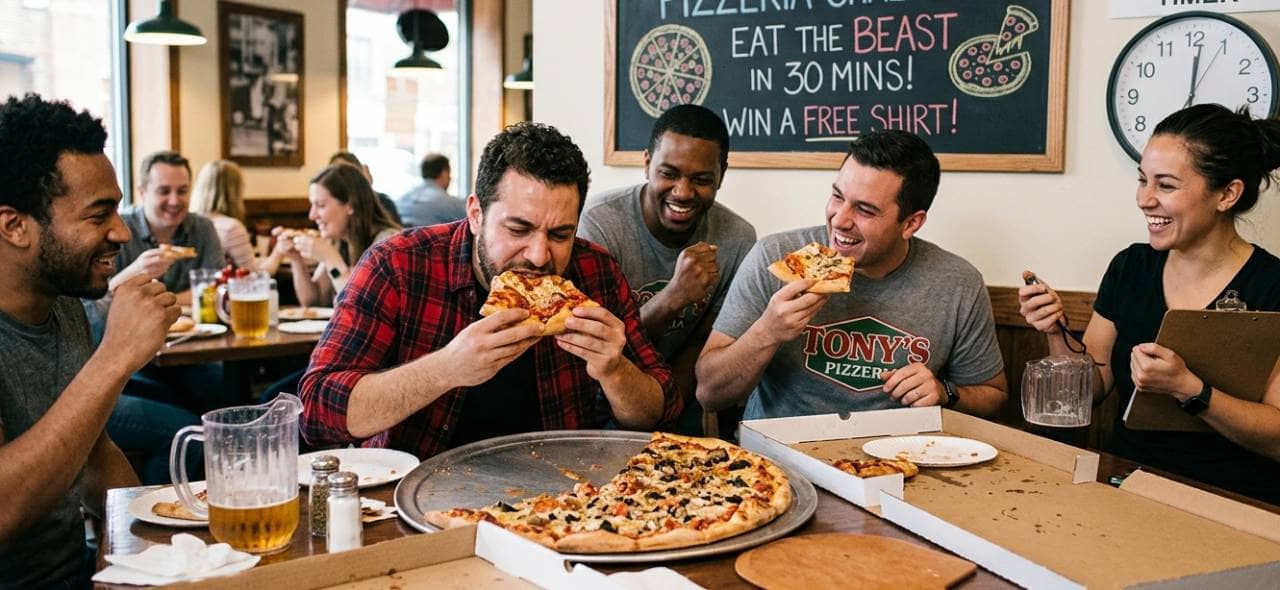
A pizzeria does not always need a large advertising budget to get attention. Sometimes, the strongest marketing comes from giving customers something worth talking about. Pizza is already a social food, which makes it ideal for challenges, limited-time offers, and menu stunts that people want to share with friends, family, and social media followers. The goal is to create a reason for customers to notice the restaurant beyond price. A regular cheese pizza may sell well, but it may not create a story. A giant slice challenge, extra-spicy pizza, oversized Sicilian tray, limited weekend-only topping combination, or "finish it in 20 minutes" meal can turn a normal visit into an experience. When customers take photos, record videos, tag friends, or bring others to watch, the promotion creates organic reach without paying for every impression. Food challenges can also increase average order value when they are built correctly. A customer may come in for the challenge, but the table may also order drinks, wings, garlic knots, salads, desserts, or additional pizzas. The challenge creates the hook, but the full check often comes from the group experience around it. A practical pizza challenge or limited-time stunt may include - 1. A clear concept - The idea should be easy to understand in one sentence, such as "finish our giant pizza in 30 minutes" or "try the hottest slice in town." 2. Strong visual appeal - Oversized pizzas, loaded toppings, bright sauces, spicy ingredients, and dramatic presentation make the promotion easier to photograph and share. 3. Simple rules - Customers should know the time limit, serving size, price, prize, and safety warnings before they participate. 4. A profitable price point - The challenge should protect food cost. Even if winners receive a prize, most participants should still generate revenue. 5. Group participation - Challenges that bring friends, families, or coworkers into the restaurant can increase total table sales. 6. Limited availability - Running the challenge only on certain days or for a limited time can create urgency and prevent the promotion from becoming stale. 7. In-store visibility - Posters, table tents, countdown boards, and winner walls can make the challenge part of the dining room experience. 8. Social media prompts - Encourage customers to tag the pizzeria, use a branded hashtag, and post their attempt for a chance to be featured. The best promotions are memorable but manageable. A challenge should not slow down the kitchen, overwhelm staff, or create waste. Owners should test the item cost, prep time, portion size, and service flow before launching it publicly. If the promotion hurts operations, the attention may not be worth it. When done well, food challenges and limited-time stunts give a pizzeria something more valuable than a discount. They create a story. Customers may forget a small coupon, but they are more likely to remember the place with the giant pizza, the spicy slice challenge, or the limited weekend special that sold out before dinner.
Local SEO is one of the most valuable marketing channels for a pizzeria because it reaches people when they already want pizza. A person searching "pizza near me," "pizza delivery in [city]," or "best pizzeria near me" is usually much closer to placing an order than someone casually scrolling through social media. That difference matters. Search traffic often comes with intent, while social media traffic often starts with attention. For independent pizzerias, this creates a major opportunity. A strong local search presence can help the restaurant show up when nearby customers are deciding what to eat for lunch, dinner, game night, family gatherings, office meals, or weekend takeout. If the pizzeria does not appear in those moments, the customer may choose a chain, a delivery app listing, or another local shop that ranks higher. The first step is making sure Google understands what the restaurant offers and where it serves customers. The website should include natural phrases such as "pizza in [city]," "pizzeria in [neighborhood]," "pizza delivery," "takeout pizza," and popular menu items. These keywords should appear in page titles, headings, homepage copy, menu descriptions, and image descriptions without sounding forced. A strong local SEO setup should focus on a few key areas - 1. Google Business Profile - The restaurant's hours, address, phone number, website, ordering link, photos, menu, and categories should be accurate and updated regularly. 2. Customer reviews - Recent reviews help build trust before the customer clicks. A pizzeria with strong ratings and steady review activity can look more reliable than one with outdated or limited feedback. 3. Website content - A thin homepage gives search engines very little to work with. Adding useful copy about the menu, ingredients, ordering options, delivery area, and neighborhood can improve relevance. 4. Food image optimization - Pizza is visual, so every image should support search. Instead of using generic file names, owners can describe the item and location, such as "pepperoni pizza in [city]" or "grandma pizza near [neighborhood]." 5. Mobile ordering flow - Visibility is only useful if customers can act quickly. The website should load fast, display well on phones, and make pickup, delivery, and phone ordering easy to find. Local SEO should also connect directly to sales tracking. Owners should look at website visits, calls, direction requests, online orders, coupon codes, and top-performing search terms. This helps show which keywords are bringing in customers and which pages need improvement. The biggest advantage of local SEO is that it keeps working after the initial setup. Paid ads stop when the budget stops. A well-optimized website, strong Google profile, fresh reviews, and useful menu pages can continue bringing nearby customers to the pizzeria every week. For owners who want more direct orders and less dependence on third-party apps, local SEO is one of the most practical places to start.
Many pizzerias treat the online menu like a digital flyer. The customer sees a list of items, prices, and maybe a short description. That can work for people who already know the restaurant, but it does very little for customers searching online for a specific craving. A customer may not search for the restaurant's name. They may search for "chicken parm near me," "grandma pizza in [city]," "best garlic knots near me," or "buffalo wings delivery." These searches are valuable because the customer already knows what they want. If the pizzeria has a dedicated page for that item, it has a better chance of showing up when the customer is ready to order. This is where menu item pages become powerful. Instead of placing every item on one long menu page, owners can create separate pages for their most profitable or most searched items. A page for "Grandma Pizza," for example, can include a strong photo, a detailed description, local keywords, customer reviews, and a direct order button. That gives search engines more information and gives customers more confidence before they buy. A strong menu item page should include - 1. A clear item name - Use the same words customers would type into Google, such as "Buffalo Chicken Pizza" or "Chicken Parm Hero." 2. A detailed description - Go beyond basic ingredients. Mention crust style, sauce, cheese, toppings, portion size, flavor profile, and what makes the item popular. 3. A high-quality photo - Show the item clearly. A strong image can create appetite faster than a long paragraph. 4. Local search wording - Add natural location phrases, such as "available for pickup and delivery in [city]" or "a customer favorite near [neighborhood]." 5. Item-specific reviews - If customers regularly mention the wings, Sicilian pizza, garlic knots, or calzones, place those reviews near the item. 6. A direct ordering path - Every page should make it easy to add the item to an online order, call the restaurant, or view pickup and delivery options. The value comes from scale. One menu item page may only bring a small amount of search traffic. But 10, 20, or 30 optimized pages can create many small entry points into the website. Each page gives the pizzeria another chance to appear when someone nearby searches for a specific dish. For independent pizzerias, this can be a low-cost way to compete with chains and delivery apps. Instead of fighting only for broad keywords like "pizza near me," the restaurant can win more specific searches tied to real menu demand. The result is more qualified traffic, more direct online orders, and a website that works harder than a basic menu page.
Getting people to the website is only half the job. The next challenge is turning those visitors into paying customers. A pizzeria may rank well on Google, get clicks from social media, and receive traffic from local searches, but if the homepage does not make ordering easy, many visitors will leave without buying. This is where conversion matters. Website traffic is attention. Online orders are revenue. If 1,000 people visit a pizzeria's website in a month and only 20 place an order, the conversion rate is 2%. If the same traffic converts at 5%, that becomes 50 orders. If it reaches 10%, that becomes 100 orders without needing more visitors. The difference comes from how quickly the website builds appetite, trust, and action. The top section of the homepage is the most important area because customers make fast decisions. Before they scroll, they should understand what kind of pizzeria it is, why the food is worth ordering, and how to place an order. If the first screen is slow, cluttered, outdated, or unclear, the restaurant may lose customers who were already interested. A stronger homepage hook should include a few essential elements - 1. A clear reason to choose the pizzeria - Use one short positioning statement that explains what makes the restaurant different, such as family-owned recipes, Brooklyn-style pizza, wood-fired pies, late-night delivery, or fresh daily dough. 2. A high-impact food photo - The first image should make customers hungry immediately. A best-selling pizza, melted cheese pull, loaded Sicilian slice, or full table spread can create a stronger reaction than a generic storefront photo. 3. A visible order button - Customers should not have to search for how to order. Buttons like "Order Online," "Start Pickup Order," or "Get Delivery" should be easy to see on mobile and desktop. 4. Trust signals - Ratings, review counts, local awards, customer quotes, or "serving [city] since [year]" can reduce hesitation and help first-time visitors feel more confident. 5. Simple navigation - The homepage should guide people toward the menu, ordering, hours, location, delivery area, and contact details without making them dig through multiple pages. Mobile experience is especially important because many pizza orders start on a phone. A customer may be hungry, in a hurry, or comparing multiple options. If the site loads slowly, the menu is hard to read, or the order button is buried, the customer may choose another restaurant before seeing the food. The best pizzeria websites do not try to say everything at once. They quickly answer the customer's main questions - Does this look good? Is it nearby? Can I order now? Do other people trust it? When the homepage answers those questions in seconds, the website becomes more than an online brochure. It becomes a direct sales tool.

A pizzeria does not grow only by finding new customers. It grows faster when past customers keep coming back. This is important because a first-time customer may require a coupon, mailer, search visit, or social media post to make the first order happen. A repeat customer is different. They already know the food, trust the restaurant, and may only need a timely reminder to order again. That is why email and text marketing can be so valuable for pizzerias. Instead of waiting for customers to remember the restaurant on their own, owners can build a direct communication channel. This matters because third-party delivery apps often control the customer relationship. The app may show the restaurant's menu, process the order, and send future promotions, but the pizzeria may not own the customer data. Email and text marketing helps bring that relationship back to the restaurant. The first step is collecting contact information. A pizzeria can invite customers to join a rewards club, birthday club, weekly deals list, or VIP pizza club. Sign-up forms can appear on the website, online ordering page, receipts, QR codes, table tents, pizza box stickers, and social media profiles. The offer should be simple- join the list and get something useful, such as a first-order discount, free garlic knots, birthday reward, or early access to limited-time specials. Once the list is built, automation can turn customer data into repeat sales. A practical system may include - 1. Welcome messages - Send new subscribers a friendly introduction, a strong food visual, and a first-order offer. 2. Reorder reminders - If a customer usually orders on Friday night, send a message before that buying window with a quick link to reorder. 3. Cross-sell offers - Promote wings, salads, desserts, drinks, or family bundles based on what customers already buy. 4. Win-back campaigns - If a regular customer has not ordered in 60 or 90 days, send a personalized message with a reason to return. 5. Event-based promotions - Use sports nights, holidays, school events, and local gatherings to promote larger orders and party packages. The strength of automation is timing. A random coupon may get ignored, but a reminder sent near dinner time, payday, game night, or a customer's normal ordering day can feel useful instead of disruptive. For example, a customer who ordered two large pizzas and wings last Friday may respond well to a message that says, "Pizza night again? Reorder your favorites in one tap." Owners should track every campaign by revenue, redemption rate, average order value, unsubscribe rate, and repeat purchase behavior. When done well, automated email and text marketing becomes a quiet sales engine. It brings customers back without relying only on ads, delivery apps, or discounts. For a pizzeria, that can mean more direct orders, stronger loyalty, and a customer base that is easier to reach whenever business needs a boost.
A pizzeria does not need to launch every marketing strategy at the same time. In fact, trying to do too much at once can make it harder to measure what is working. The better approach is to build a marketing system in stages, starting with the areas most likely to increase direct orders, repeat visits, and local awareness. The right strategy depends on the restaurant's current problem. If people nearby do not know the pizzeria exists, new mover mailers, local partnerships, and social media promotions may help create awareness. If the restaurant already gets website traffic but few online orders, the homepage, menu pages, and ordering flow may need improvement. If many customers order once but do not come back, email and text automation may create the biggest return. Owners should think of marketing as a set of connected parts, not separate campaigns. Local SEO helps customers find the pizzeria. A strong website helps turn those visitors into buyers. Direct mail introduces the restaurant to new households. Food challenges create conversation. Email and text marketing bring past customers back. When these pieces work together, each channel supports the others. A practical starting plan may include - 1. Fix the website first - Make sure the homepage, menu, order buttons, hours, address, and mobile experience are clear before sending more traffic to the site. 2. Strengthen local search visibility - Update the Google Business Profile, collect more reviews, add local keywords, and create pages for popular menu items. 3. Build a direct customer list - Capture emails and phone numbers through rewards clubs, online ordering, QR codes, receipts, and first-order offers. 4. Run targeted local campaigns - Use new mover mailers, neighborhood promotions, school partnerships, sports-night bundles, or limited-time offers to attract nearby customers. 5. Measure what actually drives orders - Track coupon codes, QR scans, online orders, repeat purchase rates, average order value, and customer sign-ups. The most important number is not always how many people see the promotion. It is how many people order, return, and spend profitably. A campaign that brings 50 loyal customers may be more valuable than one that gets 5,000 views but no sales. For independent pizzerias, the goal is control. Owners should not have to depend only on third-party apps, random discounts, or expensive ads to grow. A stronger marketing mix helps the restaurant own more of the customer relationship, turn local attention into direct orders, and keep customers coming back long after the first promotion ends.
