





How to Calculate Menu Costs for Your Restaurant
Find out how to convert purchase units into usable recipe costs, control portions, and keep your numbers accurate as ingredient prices change.


Overview
Every dish on your menu tells a financial story. Behind the appealing description and the carefully plated presentation lies a simple question that determines whether your restaurant thrives or struggles - how much does it actually cost to make this dish? Many restaurant owners price their menus based on instinct, by glancing at what competitors charge or by doubling the cost of the main ingredient. While this approach might feel reasonable, it often hides serious problems. A dish that seems profitable on paper can quietly lose money once you account for the garnish, the cooking oil, the trim you throw away, and the time your kitchen staff spends preparing it. These small, overlooked costs add up quickly, and in an industry known for thin margins, even a few percentage points can separate a healthy business from one that is barely breaking even. Accurate menu costing changes this. When you know the true cost of each item, you can price with confidence, identify which dishes drive your profits, and spot the ones that drain them. You can respond quickly when a supplier raises prices, decide whether a portion size needs adjusting, and make informed choices about which items to promote, redesign, or remove from the menu altogether. Guessing at costs, on the other hand, carries real consequences. Underpricing erodes your margins with every plate you sell. Overpricing can push customers toward competitors. Inconsistent portions create unpredictable costs from one shift to the next. And without reliable numbers, it becomes nearly impossible to tell whether a slow month is a sales problem or a cost problem. The good news is that menu costing is a learnable skill that follows a clear, repeatable process. You don't need an accounting degree or expensive software to get started, just a methodical approach and a willingness to measure what goes into each dish.
The Components of Menu Item Cost
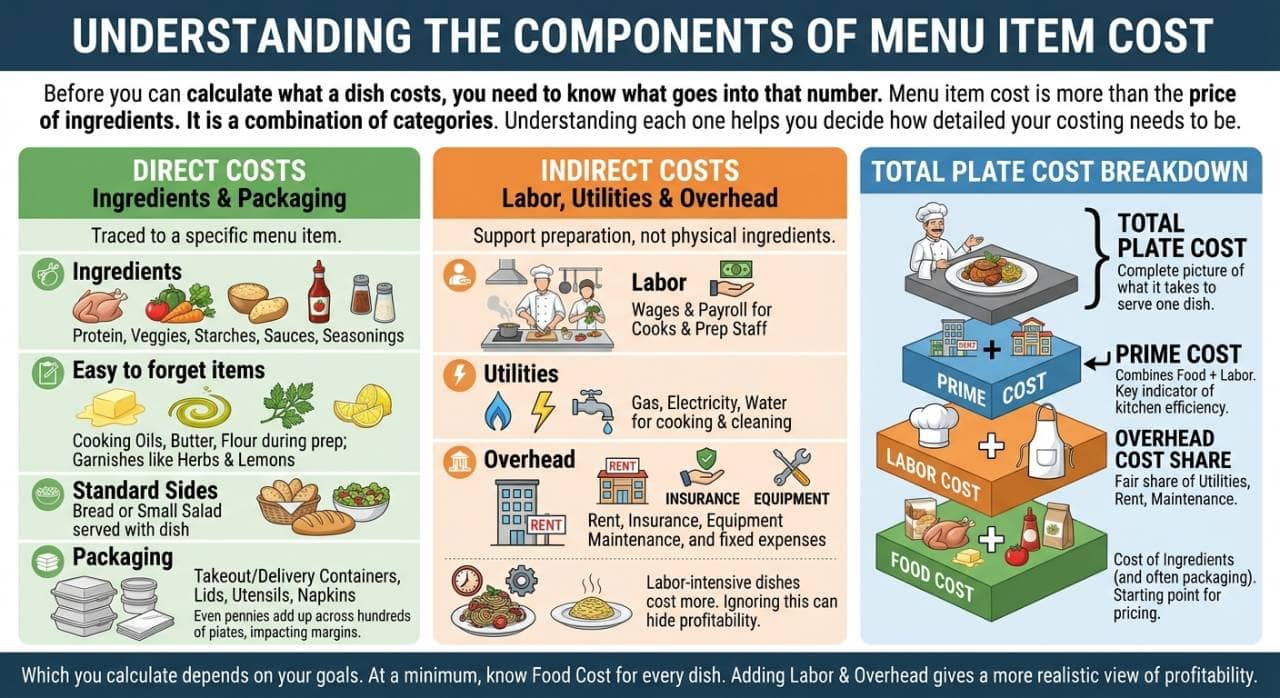
Before you can calculate what a dish costs, you need to know what goes into that number. Menu item cost is more than the price of the ingredients on the plate. It is a combination of several categories, and understanding each one helps you decide how detailed your costing needs to be. Direct Costs - Ingredients and Packaging Direct costs are the expenses that can be traced to a specific menu item. The most obvious are the ingredients - the protein, vegetables, starches, sauces, and seasonings that make up the dish. But direct costs also include items that are easy to forget, such as - - Cooking oils, butter, and flour used during preparation - Garnishes like fresh herbs, lemon wedges, or a dusting of parmesan - Side items that come standard with the dish, such as bread or a small salad - Packaging for takeout and delivery, including containers, lids, utensils, and napkins Each of these may cost only pennies per serving, but across hundreds of plates a week, they can have a noticeable effect on your margins. Indirect Costs - Labor, Utilities, and Overhead Indirect costs are the expenses that support the preparation of a dish but are not part of its physical ingredients. These include - 1. Labor - The wages and payroll costs for the cooks and prep staff who produce the item 2. Utilities - The gas, electricity, and water used to cook, hold, and clean up 3. Overhead - Rent, insurance, equipment maintenance, and other fixed expenses that keep the kitchen running Indirect costs are harder to assign to individual dishes, because a single labor hour or utility bill supports many items at once. Even so, a labor-intensive dish, such as one that requires hours of slow cooking or detailed hand preparation, costs more to produce than a simple one with the same ingredient cost. Ignoring this difference can make complex dishes look more profitable than they really are. Food Cost, Prime Cost, and Total Plate Cost Three terms come up often in restaurant costing, and it helps to keep them distinct - - Food cost is the cost of the ingredients (and, for some operators, packaging) in a dish. It is the most commonly tracked figure and the starting point for most pricing decisions. - Prime cost combines food cost with labor cost. Because these are typically the two largest expenses in a restaurant, prime cost is a useful indicator of overall kitchen efficiency. - Total plate cost adds a fair share of overhead and other preparation expenses to the prime cost, giving the most complete picture of what it takes to put one dish in front of a guest. Which of these you calculate for each menu item depends on your goals. At a minimum, every restaurant should know the food cost of every dish. As your costing process matures, adding labor and overhead gives you a more realistic view of true profitability.
Gathering Accurate Ingredient Prices
Every menu cost calculation rests on one thing - the price you actually pay for your ingredients. If those numbers are outdated or estimated, everything built on top of them will be off. Gathering accurate prices takes some upfront effort, but it is the most important step in the process. Collect Current Prices from Suppliers and Invoices Start with your most recent supplier invoices rather than memory or old price lists. Invoices show what you were really charged, including any discounts, delivery fees, or minimum-order adjustments. If you buy from several vendors, gather invoices from each one and record the price for every ingredient you use. A few practical habits make this easier - - Keep a single, organized list of all ingredients with their purchase price, supplier, and the date the price was recorded - Use the price from your most recent purchase, or an average of recent purchases if your prices vary from week to week - Note which supplier you use for each item, since the same product can cost different amounts from different vendors - Check that the product on the invoice matches what you use in the recipe, such as the same grade, brand, or cut Account for Price Fluctuations and Seasonal Changes Ingredient prices rarely stay still. Fresh produce, seafood, and some proteins can change significantly with the season, weather, or market demand. Dairy, oils, and grains may shift more gradually, but they can still move over the course of a year. To keep your costs realistic, consider these approaches - 1. Update frequently for volatile items. Track prices for produce, seafood, and other fast-changing ingredients more often, such as weekly. 2. Review stable items on a schedule. Pantry staples and dry goods may only need a monthly or quarterly check. 3. Use averages where it makes sense. If an ingredient swings widely, averaging several recent prices can give you a steadier figure for costing and pricing. 4. Flag high-impact ingredients. Identify the few ingredients that make up the largest share of your costs, since changes in their prices affect your margins the most. Convert Purchase Units into Usable Units Suppliers sell ingredients in cases, bags, flats, and cartons, but recipes call for ounces, grams, cups, or individual pieces. To cost a recipe, you need to convert the purchase price into a cost per recipe unit. The basic formula is - Cost per unit = Purchase price / Number of units in the package For example, if a 10-pound bag of rice costs $15.00, the cost per pound is $1.50. Since there are 16 ounces in a pound, the cost per ounce is about $0.094. If your recipe uses 4 ounces of rice, the rice costs roughly $0.38 per portion. A few tips for accurate conversions - - Convert everything to a consistent unit of measure, such as ounces or grams, so recipes are easy to compare - Be careful when mixing weight and volume. A cup of flour and a cup of honey do not weigh the same, so use weight measurements whenever possible - For items sold by the case, divide the case price by the total number of individual units or total weight inside - Double-check pack sizes on invoices, since suppliers sometimes change them without much notice Once you have a reliable list of ingredient prices in usable units, you are ready for the next challenge - figuring out how much of each ingredient actually ends up on the plate.
Determining Yield and Portion Sizes
Knowing what you pay for an ingredient is only half the equation. The other half is knowing how much of it actually reaches the guest. Most ingredients lose some weight or volume before they are served, and portion sizes can vary from plate to plate. Both factors directly affect what each dish really costs. As-Purchased Versus Edible Portion The weight of an ingredient when you buy it is called its as-purchased (AP) weight. The weight that remains after trimming, peeling, boning, and cooking is its edible portion (EP) weight. The difference between the two is lost to waste, and you are paying for that waste whether or not it ends up on the plate. The yield percentage tells you how much of the purchased product is usable - Yield % = Edible portion weight / As-purchased weight x 100 For example, suppose you buy a 5-pound whole beef tenderloin and, after trimming fat and silverskin, you have 3.5 pounds of usable meat. The yield is 3.5 / 5 = 70%. Once you know the yield, you can calculate the true cost of the usable product - Cost per edible unit = AP cost per unit / Yield % If the tenderloin costs $12.00 per pound as purchased, the cost per edible pound is $12.00 / 0.70, or about $17.14. That is the number you should use in your recipe costing, not the original $12.00. Adjusting for Trim, Waste, and Cooking Loss Yield is affected by more than one type of loss. To get an accurate figure, consider each stage of preparation - 1. Trim loss - Peels, stems, bones, fat, shells, and other parts removed before cooking 2. Cooking loss - Moisture and fat lost during roasting, grilling, braising, or frying, which can significantly reduce the weight of meats and some vegetables 3. Spoilage and handling waste - Product that is damaged, expired, or dropped, which can be tracked separately or built into a small waste allowance The most reliable way to find your yield is to test it yourself. Weigh the item as purchased, perform the preparation exactly as your kitchen does, and weigh the usable result. Repeat the test a few times, since results can vary by supplier, product quality, and the skill of the person doing the prep. Record the averages and keep them with your ingredient list. Keep in mind that yields differ between products. A pre-trimmed cut will have a much higher yield than a whole primal, but it also costs more per pound. Comparing cost per edible unit, rather than purchase price alone, shows which option is actually the better value. Standardizing Portions with the Right Tools Even a perfect cost calculation falls apart if portions are inconsistent. If a recipe is costed at 6 ounces of chicken but cooks routinely plate 7, your real costs will be higher than your numbers suggest, and the gap repeats with every order. Portion control tools make consistency easier - - Digital scales for proteins, cheeses, and other items sold or costed by weight - Portion scoops (dishers) for sides, doughs, and batters, with each scoop size corresponding to a set volume - Ladles and measuring spoons for sauces, soups, and dressings - Pre-portioned packaging for items that can be divided and stored in advance Alongside the tools, train your staff on the correct portions and make the standards visible, such as posting portion guides at each station. Spot-check plates during service to catch drift before it becomes a habit.
Building a Standardized Recipe Card
A standardized recipe card is the document that brings your ingredient prices, yields, and portion sizes together. It records exactly how a dish is made and exactly what it costs. Without one, every cook may prepare the dish a little differently, and you have no reliable basis for costing it. What a Standardized Recipe Card Includes A complete recipe card goes beyond a list of ingredients. At a minimum, it should include - 1. Dish name and yield - The name of the item and the total number of portions the recipe produces 2. Portion size - The exact serving size, such as 6 ounces of protein or one 4-ounce ladle of sauce 3. Ingredient list - Every item used, with its quantity and unit of measure 4. Preparation instructions - Clear, step-by-step directions so the dish turns out the same every time 5. Cooking details - Temperatures, times, and equipment 6. Plating and garnish notes - What goes on the plate and how it is presented 7. Cost information - The cost of each ingredient, the total recipe cost, and the cost per portion Using the same format for every recipe makes cards easier to read, train from, and compare across your menu. List Every Ingredient, Including the Small Ones The most common costing mistake is leaving things out. It is easy to account for the steak and the potatoes, but just as easy to forget the cooking oil, the pat of finishing butter, the pinch of salt, the sprig of parsley, or the squeeze of lemon. Individually, these seem negligible. Added together across many dishes and many orders, they can represent a meaningful share of your costs. To avoid gaps, walk through the dish as a cook would, from first prep step to final plate, and write down everything that touches the food. For items that are hard to measure precisely, such as a drizzle of oil or a pinch of seasoning, agree on a standard amount, measure it a few times, and record that figure. If a number is an estimate, it is better to include a reasonable one than to leave the ingredient out. Record Exact Quantities and Units of Measure Each ingredient should have a precise quantity and a consistent unit. Vague entries such as "a handful of cheese" or "some sauce" make costing impossible and lead to portion drift. Instead, use weights wherever you can, since they are more accurate than volume measurements, and reserve counts for items that are naturally sold or served individually, such as eggs or burger buns. Make sure the unit on the recipe card matches the unit you used when converting your ingredient prices. If you calculated rice at a cost per ounce, record the rice in ounces. Mismatched units are a common source of errors. Also, remember to account for yield. If a recipe calls for 6 ounces of trimmed tenderloin, cost it using the cost per edible ounce, not the as-purchased price. Calculate the Cost per Ingredient and Total the Recipe With quantities and prices in place, the calculation is straightforward - Ingredient cost = Quantity used x Cost per unit Do this for each ingredient, then add the results together to get the total recipe cost. For example, a simple chicken and rice plate might look like this - IngredientQuantityCost per UnitIngredient Cost
| Chicken breast (edible) | 6 oz | $0.28/oz | $1.68 |
| Rice | 4 oz | $0.094/oz | $0.38 |
| Seasonal vegetables | 3 oz | $0.20/oz | $0.60 |
| Olive oil | 0.5 oz | $0.35/oz | $0.18 |
| Garnish (fresh parsley) | 0.1 oz | $1.20/oz | $0.12 |
| Total cost per portion | $2.96 |

Factoring in Preparation Expenses
Ingredient cost tells you what goes on the plate, but it does not tell you what it takes to get it there. Cooks spend time preparing each dish, equipment uses energy, and takeout orders require packaging. Including these preparation expenses gives you a fuller and more honest picture of what each menu item costs. Estimating Labor Cost per Menu Item Labor is usually one of the largest expenses in a restaurant, yet it is often left out of menu costing because it is harder to assign to individual dishes. A practical way to do it is to estimate how much kitchen time each item requires and multiply that by your labor rate. Start with these steps - 1. Determine your average kitchen labor cost per hour. Include wages plus payroll taxes and benefits, not just the hourly pay rate. 2. Estimate the labor minutes per portion. Include prep work (chopping, marinating, making sauces) and the time spent cooking and plating. For batch-prepared items, divide the total labor time by the number of portions the batch produces. 3. Calculate the labor cost per portion. Labor cost per portion = (Labor cost per hour / 60) x Minutes per portion For example, if your loaded kitchen labor cost is $24 per hour, that is $0.40 per minute. A dish that takes 5 minutes of combined prep and cooking time per portion carries $2.00 in labor cost. A simpler dish that takes 2 minutes carries $0.80, even if the ingredients cost the same. You do not need perfect precision here. Timing a few preparations during a typical shift and averaging the results will give you a reasonable estimate. The goal is to make sure labor-intensive dishes are priced accordingly. Allocating Energy, Equipment, and Other Overhead Overhead costs, such as gas, electricity, water, equipment wear, cleaning supplies, and rent, support every dish on your menu but are not tied to any one of them. Because of this, they are usually allocated rather than measured directly. There are two common approaches - 1. Percentage method - Calculate your total monthly overhead as a percentage of total sales or total food cost, then apply that percentage to each menu item. For example, if overhead equals 15% of your food cost, add 15% to the ingredient cost of each dish. 2. Per-portion method - Divide your total monthly overhead by the total number of portions you serve in that period to get an average overhead cost per portion, then add that figure to each item. For dishes that use significantly more energy or equipment time than others, such as items that require long oven roasting or deep frying, you may want to adjust the allocation upward. The simplest approach is usually best. Choose one method, apply it consistently, and revisit it periodically. Including Packaging and Service-Ware Costs If you offer takeout or delivery, packaging is a real cost that dine-in dishes do not carry. Containers, lids, bags, cutlery, napkins, condiment packets, and sealing stickers can add up quickly, especially for delivery orders that require sturdier or insulated packaging. Handle these costs by - - Listing packaging on separate recipe cards or as a separate section for takeout versions of each dish - Costing each component individually, such as the container, lid, utensil kit, and bag, then totaling them per order - Accounting for dine-in service-ware where relevant, such as paper liners, disposable cups, or single-use items, if your restaurant uses them Because packaging costs apply only to certain orders, tracking them separately lets you see how much more a takeout dish costs to produce than the same dish served in the dining room. This can inform pricing decisions, such as adding a small packaging fee or adjusting delivery menu prices.
Calculating Cost per Portion and Food Cost Percentage
With ingredient costs, yields, and preparation expenses in hand, you can now calculate the figures that drive your pricing decisions - cost per portion and food cost percentage. These two numbers tell you what each dish costs to produce and how much of its selling price goes toward ingredients. Dividing Total Recipe Cost by Number of Portions If a recipe makes a single serving, the total recipe cost is already your cost per portion. But many kitchen recipes are prepared in batches, such as soups, sauces, braises, and casseroles. For these, the calculation is - Cost per portion = Total recipe cost / Number of portions For example, suppose a pot of tomato soup costs $18.00 in ingredients and yields 24 portions. The cost per portion is $18.00 / 24 = $0.75. If you want a fuller view of the dish, add the per-portion labor, overhead, and packaging figures from Section 6 to the ingredient cost. Many operators keep two numbers for each item - the food cost per portion (ingredients only) and the total cost per portion (ingredients plus preparation expenses). The first is used for the food cost percentage, while the second shows the true cost of making the dish. Be sure the number of portions is realistic. If a batch is supposed to make 24 portions but your cooks consistently get only 20 from it because of spillage, over-portioning, or evaporation, use the actual number. Otherwise, your cost per portion will be understated. The Food Cost Percentage Formula Food cost percentage expresses the cost of a dish as a share of its selling price. It is one of the most widely used measures in restaurant management because it lets you compare dishes of different prices on equal footing. Food cost % = (Food cost per portion / Menu price) x 100 For example, if the chicken and rice plate from Section 5 has a food cost of $2.96 and sells for $11.00, its food cost percentage is ($2.96 / $11.00) x 100, or about 26.9%. You can also work backward to find a menu price based on a target food cost percentage - Menu price = Food cost per portion / Target food cost % If you want to hold a 30% food cost and a dish costs $4.50 to make, the price would be $4.50 / 0.30 = $15.00. Typical Target Ranges Target food cost percentages vary depending on the type of restaurant, its menu, and its location. As a general guideline, many full-service restaurants aim for a food cost somewhere in the range of 28% to 35%. Quick-service and pizza concepts may run lower on some items, while operations with premium ingredients, such as steakhouses and seafood restaurants, often run higher. Treat these ranges as a starting point rather than a rule, and set your own targets based on your concept, your other expenses, and the profit you need to achieve. It is also normal for individual items to fall above or below your overall target. Pasta, soups, and other starch-based dishes often have low food cost percentages, while steaks and seafood tend to run higher. A balanced menu mixes both, so that high-cost items are offset by more profitable ones. Using Cost Data to Set Prices and Review Margins Food cost percentage is a useful starting point for pricing, but it should not be the only factor. Consider these questions when setting or adjusting a menu price - 1. What is the dollar profit? A lower-percentage dish is not always the better earner. A $30 entree at 38% food cost leaves more dollars in your pocket per plate than a $6 appetizer at 25%. 2. What do competitors and customers expect? Your price needs to fit what guests in your market are willing to pay for that type of dish. 3. Does the price cover labor and overhead? If you have calculated total cost per portion, check that the price leaves room for those expenses and a profit. 4. How does the dish fit into the overall menu? Some items, such as popular signature dishes, may be priced to attract customers, while others are priced to lift your overall margin. Reviewing these figures across your whole menu reveals which dishes are carrying the business and which ones need attention, whether through a price change, a portion adjustment, a recipe tweak, or removal from the menu.