






How to Write a HACCP Plan for Your Restaurant Kitchen
Learn how to write a HACCP plan for your restaurant by identifying food safety hazards, establishing critical controls, monitoring procedures, and maintaining documentation.

Why Your Restaurant Needs a HACCP Plan
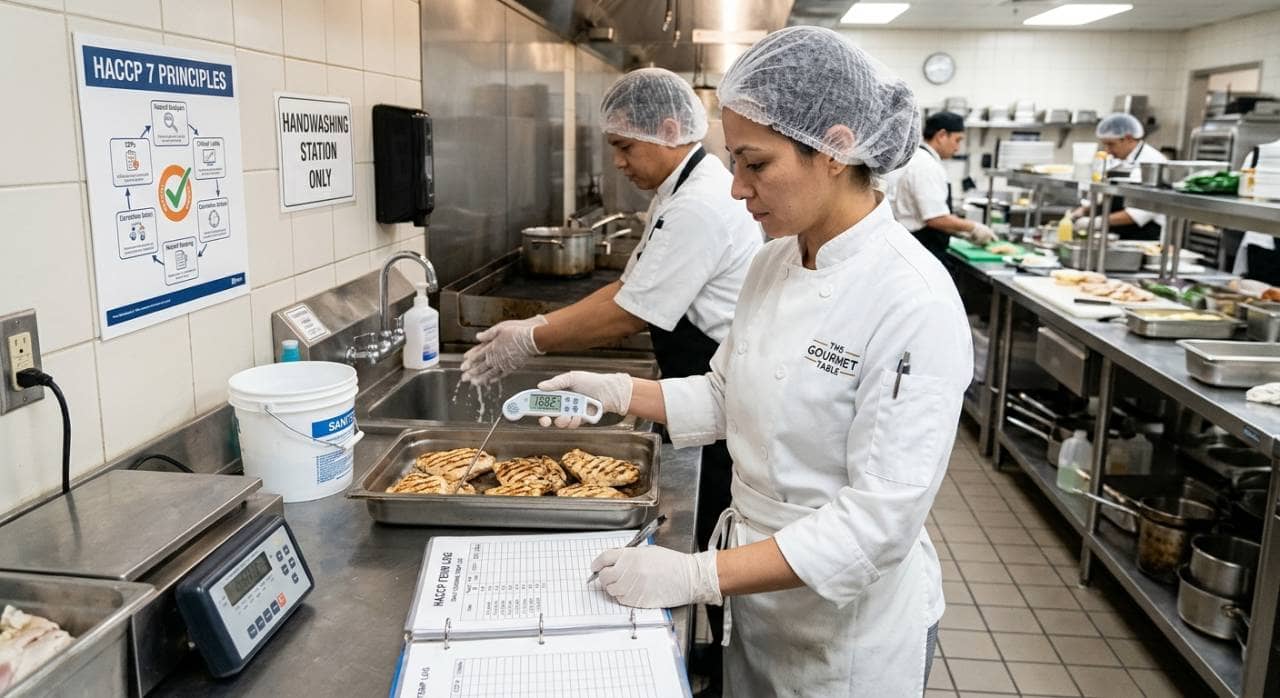
Food safety is one of the most important responsibilities in restaurant operations. Every day, restaurant employees receive ingredients, store perishable foods, prepare meals, cook dishes, and serve customers. Each stage creates opportunities for food safety hazards if proper handling procedures are not followed. Improper storage temperatures, cross-contamination, inadequate cooking, and poor sanitation can expose customers to foodborne illnesses and create serious operational risks. A Hazard Analysis and Critical Control Points (HACCP) plan provides a structured approach to identifying, preventing, and controlling these hazards throughout food preparation. Rather than relying entirely on final product inspections, HACCP focuses on identifying potential problems before they compromise food safety. It establishes procedures for monitoring important stages of food handling and taking corrective action when established safety limits are not met. For restaurant owners, writing a HACCP plan means documenting how food moves through the kitchen, identifying potential biological, chemical, and physical hazards, and determining where controls are necessary. It also involves establishing monitoring procedures, assigning employee responsibilities, maintaining food safety records, and verifying that established controls work as intended. A properly developed HACCP plan should reflect the restaurant's actual menu, ingredients, equipment, preparation methods, and kitchen processes. A generic document may provide a starting point, but it cannot replace an assessment of the specific food safety risks associated with daily operations. By following a structured process, restaurant owners can develop practical food safety procedures that employees can understand, follow, and maintain. The first step is understanding how the kitchen operates and identifying the information needed to build an effective food safety plan.
Assess Your Kitchen Operations
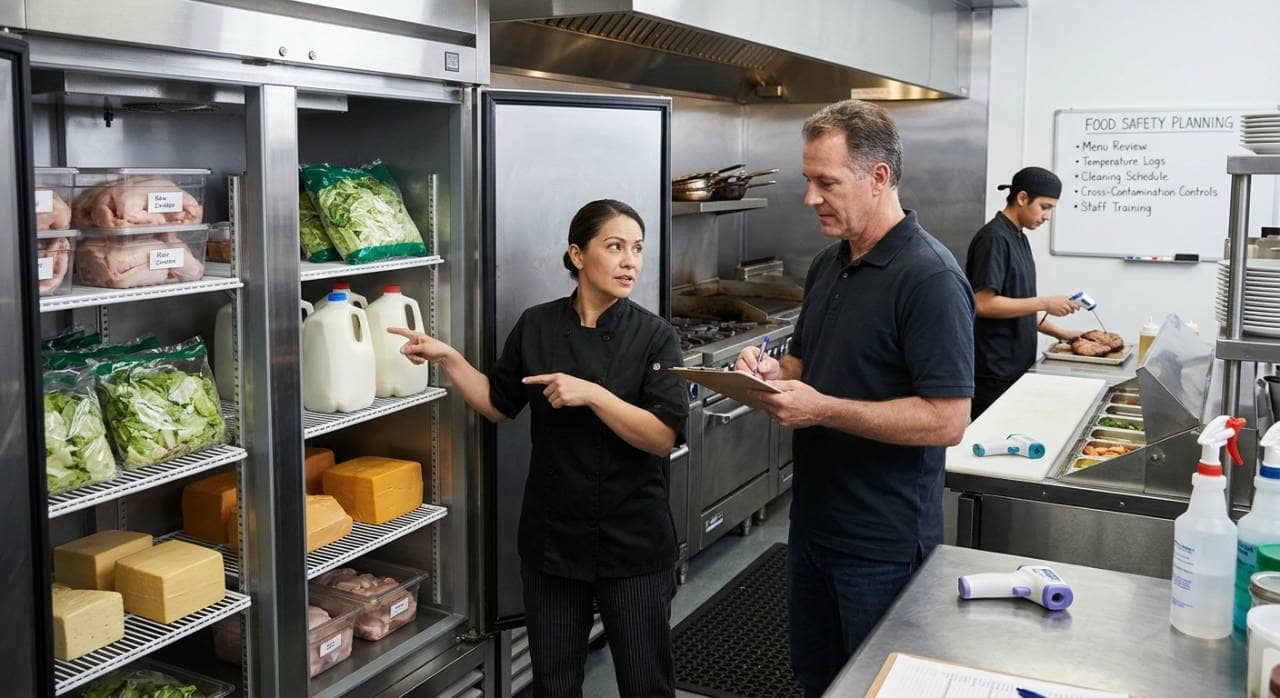
Before writing a HACCP plan, restaurant owners need to understand how their kitchens operate. Every restaurant has different menus, ingredients, equipment, food preparation methods, and storage procedures. These differences influence the types of food safety hazards that may occur and the controls needed to prevent them. Starting with a detailed assessment of kitchen operations helps ensure the HACCP plan reflects actual working conditions rather than relying on generic food safety procedures. The first step is to gather information about the restaurant's food handling activities. Identify the Types of Food Prepared Start by reviewing the restaurant's menu and identifying the foods prepared and served. Pay particular attention to ingredients that require temperature control or specific handling procedures. Consider the following - Raw ingredients, including meat, poultry, seafood, and eggs. - Dairy products and other refrigerated ingredients. - Ready-to-eat foods, including salads, sandwiches, and prepared desserts. - Frozen ingredients that require thawing before preparation. - Cooked foods that require cooling, reheating, or hot holding. This inventory helps determine which foods require additional safety controls during preparation and storage. Review Equipment and Storage Areas Identify the equipment used to receive, store, prepare, cook, and hold food. This includes refrigerators, freezers, cooking equipment, food preparation surfaces, thermometers, and hot-holding units. Evaluate whether equipment can maintain appropriate food safety conditions and whether employees have access to the tools needed to monitor temperatures. Equipment limitations or inconsistent performance can create hazards that should be addressed in the HACCP plan. Document Existing Food Safety Procedures Review the restaurant's current procedures for receiving deliveries, checking ingredient temperatures, storing food, cleaning surfaces, preventing cross-contamination, and maintaining employee hygiene. These foundational activities are often managed through prerequisite programs, which support the HACCP system by establishing basic sanitation and food handling conditions. Assign Food Safety Responsibilities Determine who is responsible for managing food safety activities. Restaurant owners may assign responsibilities to kitchen managers, chefs, shift supervisors, and food handlers. Clearly defined responsibilities help ensure employees understand who checks temperatures, inspects deliveries, maintains records, and responds when food safety procedures are not followed. Once this information has been collected, restaurant owners have a clearer understanding of their kitchen operations and the potential risks associated with each activity. This information provides the foundation for the next step - mapping the restaurant's food preparation and handling processes.
Map Your Food Handling Processes
After gathering information about kitchen operations, the next step is to map how food moves through the restaurant. A food process flow diagram provides a visual representation of every stage, starting when ingredients arrive at the restaurant and ending when prepared meals are served to customers. This step is important because food safety hazards can occur at different points throughout the process, not just during cooking. Create a Food Preparation Flow Diagram Start by documenting the sequence of activities involved in handling food. Although processes vary depending on the restaurant's menu and kitchen setup, a typical food preparation flow may include - 1. Receiving - Ingredients arrive from suppliers and are inspected for quality, packaging conditions, and appropriate temperatures. 2. Storage - Food is placed in refrigerators, freezers, or dry storage areas according to its storage requirements. 3. Preparation - Ingredients are washed, cut, portioned, seasoned, or combined before cooking. 4. Cooking - Food is prepared using appropriate cooking methods and monitored to ensure required temperatures are reached. 5. Cooling - Cooked food intended for later use is cooled using established time and temperature controls. 6. Reheating - Previously cooked and cooled food is reheated according to applicable food safety requirements. 7. Holding - Prepared food is maintained at appropriate hot or cold holding temperatures until service. 8. Serving - Food is plated, packaged, or delivered to customers using safe handling practices. Identify Potential Risks at Each Stage Once the flow diagram is complete, review each activity to identify where contamination, bacterial growth, or other food safety problems could occur. For example, raw poultry stored above ready-to-eat ingredients may create a cross-contamination risk. Leaving refrigerated ingredients at room temperature during preparation may allow harmful bacteria to multiply. Similarly, inadequate cooling procedures can create conditions that increase the risk of bacterial growth. Consider the following questions when reviewing each stage - - Can raw and ready-to-eat foods come into contact? - Are ingredients maintained at appropriate storage temperatures? - Could employees introduce contamination through improper handling? - Are cooking, cooling, and reheating procedures properly controlled? - Can equipment or preparation surfaces introduce physical or chemical hazards? Verify the Flow Diagram Against Actual Kitchen Practices A flow diagram should represent what employees actually do, not simply describe an ideal preparation process. Walk through the kitchen and compare each documented step with daily operations. Speak with employees to identify additional activities, temporary storage practices, or preparation methods that may have been overlooked. If the restaurant prepares different categories of food using separate processes, create additional flow diagrams where necessary. For example, raw poultry preparation and ready-to-eat salad preparation may require different handling procedures and hazard assessments. A complete and accurate flow diagram gives restaurant owners a clear picture of how food moves through their kitchens. More importantly, it provides the foundation for conducting a hazard analysis and determining where food safety controls are necessary.
Conduct a Food Safety Hazard Analysis
Once the restaurant's food preparation and handling processes have been mapped, the next step is to conduct a food safety hazard analysis. This involves identifying potential hazards at every stage of food handling, evaluating how serious they could be, and determining what measures are needed to prevent or control them. Hazard analysis is one of the most important parts of writing a HACCP plan because it helps restaurant owners understand where food safety problems can occur and which risks require additional attention. Identify the Three Main Types of Food Safety Hazards Start by reviewing the three primary categories of hazards that can affect food safety. 1. Biological Hazards - These include harmful bacteria, viruses, parasites, and other microorganisms that can cause foodborne illnesses. Common examples include Salmonella, E. coli, and Listeria. Biological hazards may occur when food is stored at improper temperatures, undercooked, or exposed to contaminated surfaces. 2. Chemical Hazards - These involve harmful substances that may contaminate food during storage, preparation, or cleaning. Examples include cleaning chemicals, pesticides, sanitizing agents, and undeclared allergens. Proper chemical storage, labeling, and allergen handling procedures help reduce these risks. 3. Physical Hazards - These are foreign objects that can accidentally enter food and create safety risks. Examples include glass fragments, metal pieces, plastic, and packaging materials. Regular equipment inspections and proper food handling practices help prevent physical contamination. Evaluate the Likelihood and Severity of Each Hazard Identifying hazards is only the first part of the analysis. Restaurant owners must also evaluate how likely each hazard is to occur and how serious its consequences could be. For example, storing raw poultry above ready-to-eat ingredients creates a potential cross-contamination hazard. Inadequate refrigeration may also allow harmful bacteria to multiply. Both situations require appropriate preventive measures. Consider these questions when assessing each hazard - - How likely is the hazard to occur during normal kitchen operations? - Could the hazard cause foodborne illness or injury? - What conditions could increase the risk? - Are existing food safety procedures sufficient to control it? - Does the hazard require a specific control measure within the HACCP plan? Document Hazards and Their Preventive Measures Every significant hazard identified during the analysis should be documented. Record the preparation stage, the potential hazard, its significance, and the preventive measures needed to control it. For example, during refrigerated storage, biological hazards may result from inadequate temperature control. Preventive measures could include maintaining appropriate refrigeration temperatures, using calibrated thermometers, and conducting routine temperature checks. It is also important to distinguish between hazards controlled through prerequisite programs and those requiring specific HACCP controls. General sanitation, pest management, and employee hygiene are typically addressed through prerequisite programs, while significant hazards requiring control at specific processing steps must be evaluated for critical control points. A thorough hazard analysis helps restaurant owners determine which food safety risks require attention and provides the information needed for the next step - identifying critical control points and establishing critical limits.
Critical Control Points and Critical Limits
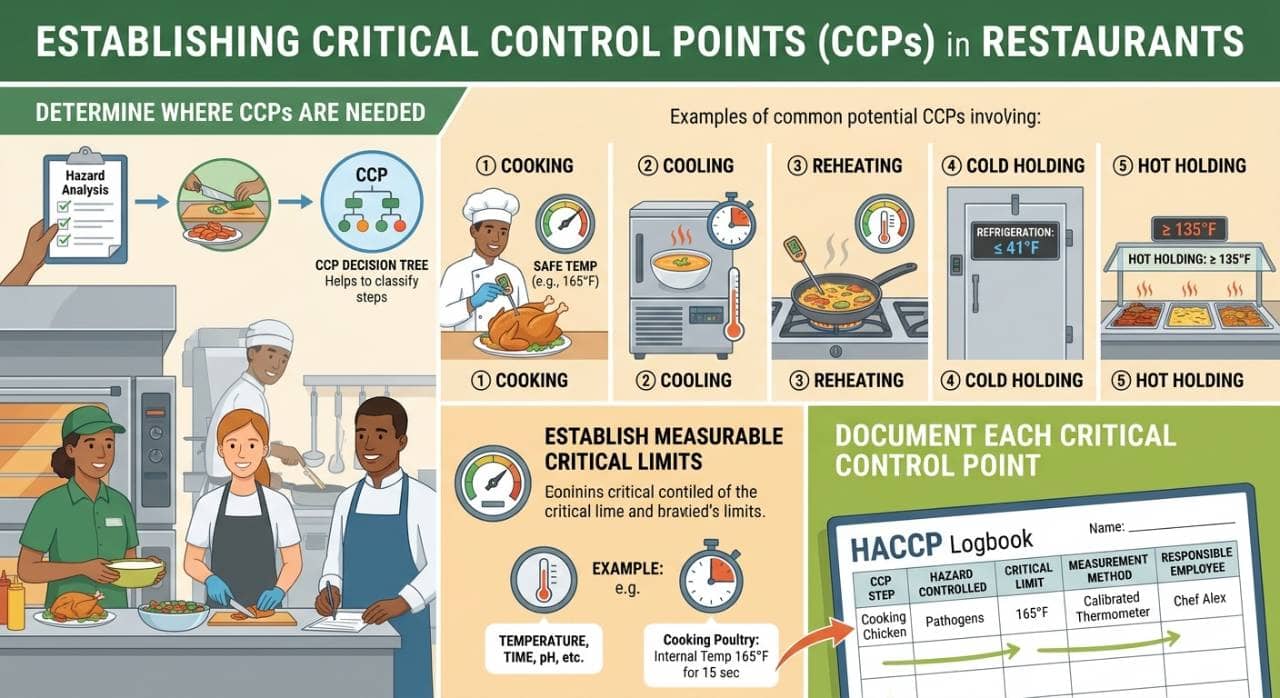
After completing the hazard analysis, restaurant owners need to determine where specific food safety controls are essential. These points are known as Critical Control Points (CCPs). A CCP is a step in food preparation or handling where control can be applied to prevent, eliminate, or reduce a significant food safety hazard to an acceptable level. Identifying CCPs helps restaurant owners focus their monitoring efforts on the stages where losing control could result in unsafe food. Determine Where Critical Control Points Are Needed Review the hazards identified in the previous step and determine which preparation stages require specific controls. Not every kitchen activity qualifies as a CCP. Some hazards can be managed through general sanitation procedures or other prerequisite programs. Common examples of potential CCPs include - 1. Cooking - Monitoring internal food temperatures to control harmful bacteria. 2. Cooling - Controlling cooling time and temperature to prevent bacterial growth. 3. Reheating - Ensuring previously cooked food reaches the required reheating temperature. 4. Cold Holding - Maintaining appropriate refrigeration temperatures to limit bacterial growth. 5. Hot Holding - Keeping prepared food at safe holding temperatures until service. The actual CCPs depend on the restaurant's menu, preparation methods, equipment, and hazard analysis. Restaurant owners can use a CCP decision tree to determine whether a particular processing step requires a critical control point. Establish Measurable Critical Limits Once CCPs have been identified, establish critical limits for each one. A critical limit is a measurable boundary that separates acceptable food safety conditions from unacceptable ones. These limits may involve temperature, time, pH, or other measurable factors depending on the hazard being controlled. For example, a restaurant may establish specific temperature and time requirements for cooking poultry, cooling prepared foods, or maintaining refrigerated ingredients. These requirements should be based on applicable food safety regulations and scientifically supported standards rather than arbitrary internal targets. Document Each Critical Control Point Every CCP should be clearly documented in the HACCP plan. Restaurant owners should record - - The food preparation or handling step where the CCP occurs. - The specific food safety hazard being controlled. - The critical limit that must be maintained. - The method used to measure or evaluate the limit. - The employee responsible for monitoring the CCP. For example, if cooking is identified as a CCP, the HACCP plan should specify the required internal temperature, how employees will measure it using a calibrated food thermometer, and how the results will be recorded. Establishing clear CCPs and measurable critical limits gives kitchen employees specific requirements to follow during food preparation. These controls also provide the foundation for creating monitoring procedures and corrective actions when food safety limits are not met.
Monitoring Procedures and Corrective Actions
After identifying critical control points and establishing critical limits, the next step is to determine how restaurant employees will monitor these controls. Monitoring procedures help ensure that food preparation and handling activities remain within established safety limits. Restaurant owners must also define what employees should do when monitoring reveals that a critical limit has not been met. Establish Monitoring Methods for Each CCP Every critical control point needs a monitoring procedure that explains what employees should check, how they should check it, and when monitoring should take place. Depending on the food preparation process, monitoring may involve - 1. Temperature Checks - Use calibrated food thermometers to measure internal cooking temperatures, refrigeration conditions, and hot or cold holding temperatures. 2. Visual Inspections - Check food handling conditions, storage arrangements, and potential contamination risks. 3. Time Monitoring - Record how long food remains in specific preparation, cooling, or holding stages. 4. Equipment Checks - Inspect refrigerators, freezers, cooking equipment, and holding units to ensure they operate within established requirements. Monitoring procedures should be specific to each CCP. For example, if cooking is identified as a CCP, the HACCP plan should explain which foods require temperature checks, how employees should measure internal temperatures, and what results must be recorded. Assign Employee Responsibilities Restaurant owners should identify which employees are responsible for monitoring each critical control point. Kitchen managers, chefs, and designated food handlers may perform these checks depending on the restaurant's staffing structure. The HACCP plan should clearly document employee responsibilities, monitoring frequencies, and reporting procedures. Employees must also understand how to use monitoring equipment correctly and recognize when a critical limit has been exceeded. Define Corrective Actions for Food Safety Deviations Monitoring alone cannot prevent unsafe food from reaching customers. Restaurant owners must establish corrective actions that employees can follow when a critical limit is not met. A corrective action procedure should explain how to address the immediate problem, determine what happened, and prevent the issue from recurring. For example - - If food does not reach the required cooking temperature, continue cooking when appropriate and verify that the critical limit is achieved before service. - If refrigerated food has been exposed to temperatures outside established limits, evaluate its safety based on the time and temperature history and follow the appropriate disposition procedure. - If cooling requirements are not met, follow the established corrective action, which may include rapid cooling when safe and permitted or discarding the affected food. - If monitoring equipment is not functioning correctly, use a suitable calibrated alternative and assess whether previously monitored food may have been affected. Document Monitoring Results and Corrective Actions Every monitoring activity should be recorded to demonstrate whether established critical limits were maintained. When a deviation occurs, employees should document the problem, the affected food, the corrective action taken, and the person responsible. These records help restaurant managers identify recurring problems, evaluate employee compliance, and determine whether additional training or operational changes are necessary. By establishing clear monitoring procedures and corrective actions, restaurant owners can turn their HACCP plan into a practical system for controlling food safety risks during daily kitchen operations. The next step is creating verification and recordkeeping systems to ensure these controls continue working as intended.
Create HACCP Verification and Recordkeeping Systems
After establishing monitoring procedures and corrective actions, restaurant owners need a system for verifying that their HACCP plan is working effectively. Monitoring checks whether employees are following established food safety controls, while verification evaluates whether those controls are properly designed, consistently implemented, and effective at managing identified hazards. Without verification and accurate documentation, restaurant owners may struggle to identify recurring problems, confirm that procedures are being followed, or demonstrate that food safety requirements are being maintained. Establish HACCP Verification Procedures Verification activities help determine whether the HACCP plan accurately reflects kitchen operations and whether established controls are working as intended. Restaurant owners should establish procedures for - 1. Reviewing Monitoring Records - Regularly examine cooking temperatures, cooling logs, refrigeration records, and other monitoring documents to identify missed checks or repeated deviations. 2. Inspecting Kitchen Operations - Conduct routine inspections to confirm employees follow food handling procedures and maintain established critical limits. 3. Calibrating Equipment - Check and calibrate food thermometers and other monitoring instruments to ensure measurements are accurate. 4. Reviewing Corrective Actions - Examine records of food safety deviations to determine whether problems were addressed appropriately. 5. Reassessing the HACCP Plan - Review the plan when ingredients, menus, equipment, preparation methods, or other operational conditions change. Verification activities should be assigned to responsible employees and performed at defined intervals. Where appropriate, independent verification can provide additional confidence that the HACCP system is functioning correctly. Maintain Essential HACCP Documentation Recordkeeping provides written evidence that food safety procedures are being implemented and monitored. Every restaurant should establish a documentation system that identifies what information must be recorded, who is responsible for maintaining it, and how long records should be retained. Important HACCP documents may include - 1. Hazard Analysis Worksheets - Document identified biological, chemical, and physical hazards, their significance, and the measures used to control them. 2. CCP Monitoring Logs - Record measurements and observations collected at each critical control point. 3. Cooking and Cooling Temperature Records - Track whether food preparation processes meet established time and temperature requirements. 4. Corrective Action Reports - Document deviations from critical limits, actions taken, and the disposition of affected food. 5. Equipment Calibration Records - Maintain information about thermometer calibration and other monitoring equipment checks. 6. Verification Records - Document inspections, record reviews, and activities used to evaluate HACCP effectiveness. 7. Employee Training Records - Maintain documentation showing that employees have received relevant food safety training and understand their responsibilities. Create an Organized Recordkeeping System Restaurant owners should make HACCP documentation easy for employees to complete, access, and review. Records can be maintained using paper forms, digital logs, or food safety management systems, provided they capture the required information accurately. Each record should include relevant details such as the date, time, monitoring results, employee responsible, and corrective actions when necessary. Managers should also establish procedures for reviewing incomplete records and retaining documentation according to applicable regulatory requirements. A consistent verification and recordkeeping system helps restaurant owners evaluate food safety performance, identify weaknesses, and maintain accountability. With these systems established, the HACCP plan is ready to move from documentation into daily kitchen operations.
Implement, Review, and Maintain
Writing a HACCP plan is only the beginning of managing food safety in a restaurant. Once the document is complete, restaurant owners must put its procedures into practice and ensure employees consistently follow the established controls. A HACCP plan is only effective when it reflects actual kitchen operations and becomes part of everyday food handling activities. Train Employees on HACCP Procedures Start by making sure kitchen employees understand the food safety procedures relevant to their responsibilities. Training should cover how to handle ingredients, prevent cross-contamination, monitor critical control points, and respond when established safety limits are not met. Employees should also understand how to complete monitoring logs, use food thermometers, and report food safety concerns to their supervisors. Restaurant managers should provide clear instructions and make relevant HACCP procedures accessible to employees during their shifts. Additional training may be necessary when new employees join the team or food preparation procedures change. Integrate HACCP Procedures Into Daily Kitchen Operations HACCP activities should become part of routine kitchen responsibilities rather than separate administrative tasks. Managers can establish daily procedures to ensure important food safety controls are consistently followed. For example - - Check refrigeration and freezer temperatures according to established monitoring schedules. - Verify cooking temperatures for foods identified as requiring CCP monitoring. - Follow documented cooling and reheating procedures. - Inspect food storage areas for contamination risks. - Complete monitoring records and document corrective actions. - Review food safety logs to identify missed checks or recurring problems. Assigning clear responsibilities and establishing consistent monitoring schedules helps prevent important food safety activities from being overlooked. Review and Update the HACCP Plan Regularly Restaurant operations can change over time. New menu items, different ingredients, updated equipment, and changes to food preparation methods may introduce hazards that were not considered when the original plan was developed. Restaurant owners should review their HACCP plans whenever significant operational changes occur. They should also conduct periodic reassessments to confirm that hazard analyses, critical control points, monitoring procedures, and corrective actions remain appropriate. If a new food preparation process introduces additional risks, the restaurant may need to update its flow diagrams, reassess potential hazards, and establish new control measures. Maintain Compliance With Applicable Food Safety Requirements Restaurant owners should ensure their HACCP plans align with applicable local food safety regulations and industry requirements. Regulatory expectations can differ depending on the jurisdiction, food operation, and types of food being prepared. Keeping documentation organized, reviewing procedures, and maintaining employee training records can help restaurants demonstrate that food safety controls are being implemented consistently. By combining employee training, routine monitoring, proper documentation, and regular reviews, restaurants can establish a structured approach to preventing food safety hazards and maintaining safer kitchen operations.